Author: Ardhi

  • Efficiency is the Enemy


    Daripada menganggur, ke depannya blog ini akan saya isi dengan artikel-artikel menarik dari internet (sekaligus sebagai arsip pribadi, andai suatu hari penulis artikel tersebut menghapus tulisannya dari internet). Pekan ini saya ingin membagikan artikel dari Farnam Street. Silakan kunjungi situs aslinya di fs.blog.


    There’s a good chance most of the problems in your life and work come down to insufficient slack. Here’s how slack works and why you need more of it.

    Imagine if you, as a budding productivity enthusiast, one day gained access to a time machine and decided to take a trip back several decades to the office of one of your old-timey business heroes. Let’s call him Tony.

    You disguise yourself as a janitor and figure a few days of observation should be enough to reveal the secret of that CEO’s incredible productivity and shrewd decision-making. You want to learn the habits and methods that enabled him to transform an entire industry for good.

    Arriving at the (no doubt smoke-filled) office, you’re a little surprised to find it’s far from a hive of activity. In fact, the people you can see around seem to be doing next to nothing. Outside your hero’s office, his secretary lounges at her desk (and let’s face it, the genders wouldn’t have been the other way around.) Let’s call her Gloria. She doesn’t appear busy at all. You observe for half an hour as she reads, tidies her desk, and chats with other secretaries who pass by. They don’t seem busy either. Confused as to why Tony would squander money on idle staff, you stick around for a few more hours.

    With a bit more observation, you realize your initial impression was entirely wrong. Gloria does indeed do nothing much of the time. But every so often, a request, instruction, or alert comes from Tony and she leaps into action. Within minutes, she answers the call, sends the letter, reschedules the appointment, or finds the right document. Any time he has a problem, she solves it right away. There’s no to-do list, no submitting a ticket, no waiting for a reply to an email for either Tony or Gloria.

    As a result, Tony’s day goes smoothly and efficiently. Every minute of his time goes on the most important part of his work — making decisions — and not on dealing with trivial inconveniences like waiting in line at the post office.

    All that time Gloria spends doing nothing isn’t wasted time. It’s slack: excess capacity allowing for responsiveness and flexibility. The slack time is important because it means she never has a backlog of tasks to complete. She can always deal with anything new straight away. Gloria’s job is to ensure Tony is as busy as he needs to be. It’s not to be as busy as possible.

    If you ever find yourself stressed, overwhelmed, sinking into stasis despite wanting to change, or frustrated when you can’t respond to new opportunities, you need more slack in your life.

    In Slack: Getting Past Burnout, Busywork, and the Myth of Total Efficiency, Tom DeMarco explains that most people and organizations fail to recognize the value of slack. Although the book is now around twenty years old, its primary message is timeless and worth revisiting.


    The enemy of efficiency

    “You’re efficient when you do something with minimum waste. And you’re effective when you’re doing the right something.”

    Many organizations are obsessed with efficiency. They want to be sure every resource is utilized to its fullest capacity and everyone is sprinting around every minute of the day doing something. They hire expert consultants to sniff out the faintest whiff of waste.

    As individuals, many of us are also obsessed with the mirage of total efficiency. We schedule every minute of our day, pride ourselves on forgoing breaks, and berate ourselves for the slightest moment of distraction. We view sleep, sickness, and burnout as unwelcome weaknesses and idolize those who never seem to succumb to them. This view, however, fails to recognize that efficiency and effectiveness are not the same thing.

    Total efficiency is a myth. Let’s return to Gloria and Tony. Imagine if Tony decided to assign her more work to ensure she spends a full eight hours a day busy. Would that be more efficient? Not really. Slack time enables her to respond to his requests right away, thus being effective at her job. If Gloria is already occupied, Tony will have to wait and whatever he’s doing will get held up. Both of them would be less effective as a result.

    Any time we eliminate slack, we create a build-up of work. DeMarco writes, “As a practical matter, it is impossible to keep everyone in the organization 100 percent busy unless we allow for some buffering at each employee’s desk. That means there is an inbox where work stacks up.

    Many of us have come to expect work to involve no slack time because of the negative way we perceive it. In a world of manic efficiency, slack often comes across as laziness or a lack of initiative. Without slack time, however, we know we won’t be able to get through new tasks straight away, and if someone insists we should, we have to drop whatever we were previously doing. One way or another, something gets delayed. The increase in busyness may well be futile:

    “It’s possible to make an organization more efficient without making it better. That’s what happens when you drive out slack. It’s also possible to make an organization a little less efficient and improve it enormously. In order to do that, you need to reintroduce enough slack to allow the organization to breathe, reinvent itself, and make necessary change.”


    Defining slack

    DeMarco defines slack as “the degree of freedom required to effect change. Slack is the natural enemy of efficiency and efficiency is the natural enemy of slack.” Elsewhere, he writes: “Slack represents operational capacity sacrificed in the interests of long-term health.

    To illustrate the concept, DeMarco asks the reader to imagine one of those puzzle games consisting of eight numbered tiles in a box, with one empty space so you can slide them around one at a time. The objective is to shuffle the tiles into numerical order. That empty space is the equivalent of slack. If you remove it, the game is technically more efficient, but “something else is lost. Without the open space, there is no further possibility of moving tiles at all. The layout is optimal as it is, but if time proves otherwise, there is no way to change it.

    Having a little bit of wiggle room allows us to respond to changing circumstances, to experiment, and to do things that might not work.

    Slack consists of excess resources. It might be time, money, people on a job, or even expectations. Slack is vital because it prevents us from getting locked into our current state, unable to respond or adapt because we just don’t have the capacity.

    Not having slack is taxing. Scarcity weighs on our minds and uses up energy that could go toward doing the task at hand better. It amplifies the impact of failures and unintended consequences.

    Too much slack is bad because resources get wasted and people get bored. But, on the whole, an absence of slack is a problem far more often than an excess of it. If you give yourself too much slack time when scheduling a project that goes smoother than expected, you probably won’t spend the spare time sitting like a lemon. Maybe you’ll recuperate from an earlier project that took more effort than anticipated. Maybe you’ll tinker with some on-hold projects. Maybe you’ll be able to review why this one went well and derive lessons for the future. And maybe slack time is just your reward for doing a good job already! You deserve breathing room.

    Slack also allows us to handle the inevitable shocks and surprises of life. If every hour in our schedules is accounted for, we can’t slow down to recover from a minor cold, shift a bit of focus to learning a new skill for a while, or absorb a couple of hours of technical difficulties.

    In general, you need more slack than you expect. Unless you have a lot of practice, your estimations of how long things will take or how difficult they are will almost always be on the low end. Most of us treat best-case scenarios as if they are the most likely scenarios and will inevitably come to pass, but they rarely do.

    You also need to keep a vigilant eye on how fast you use up your slack so you can replenish it in time. For example, you might want to review your calendar once per week to check it still has white space each day and you haven’t allowed meetings to fill up your slack time. Think of the forms of slack that are more important to you, then check up on them regularly. If you find you’re running out of slack, take action.

    Once in a while, you might need to forgo slack to reap the benefits of constraints. Lacking slack in the short term or in a particular area can force you to be more inventive. If you find yourself struggling to come up with a creative solution, try consciously reducing your slack. For example, give yourself five-minutes to brainstorm ideas or ask yourself what you might do if your budget were slashed by 90%.

    Most of the time, though, it’s critical to guard your slack with care. It’s best to assume you’ll always tend toward using it up — or other people will try to steal it from you. Set clear boundaries in your work and keep an eye on tasks that might inflate.


    Slack and change

    In the past, people and organizations could sometimes get by without much slack — at least for a while. Now, even as slack keeps becoming more and more vital for survival, we’re keener than ever to eliminate it in the name of efficiency. Survival requires constant change and reinvention, which “require a commodity that is absent in our time as it has never been before. That commodity — the catalytic ingredient of change—is slack.” DeMarco goes on to write:

    “Slack is the time when reinvention happens. It is time when you are not 100 percent busy doing the operational business of your firm. Slack is the time when you are 0 percent busy. Slack at all levels is necessary to make the organization work effectively and to grow. It is the lubricant of change. Good companies excel in creative use of slack. And bad ones only obsess about removing it.”

    Only when we are 0 percent busy can we step back and look at the bigger picture of what we’re doing. Slack allows us to think ahead. To consider whether we’re on the right trajectory. To contemplate unseen problems. To mull over information. To decide if we’re making the right trade-offs. To do things that aren’t scalable or that might not have a chance to prove profitable for a while. To walk away from bad deals.

    Slack and productivity

    The irony is that we achieve far more in the long run when we have slack. We are more productive when we don’t try to be productive all the time.

    DeMarco explains that the amount of work each person in an organization has is never static: “Things change on a day-to-day basis. This results in new unevenness of the tasks, with some people incurring additional work (their buffers build up), while others become less loaded, since someone ahead of them in the work chain is slower to generate their particular kind of work to pass along.” An absence of slack is unsustainable. Inevitably, we end up needing additional resources, which have to come from somewhere.

    Being comfortable with sometimes being 0 percent busy means we think about whether we’re doing the right thing. This is in contrast to grabbing the first task we see so no one thinks we’re lazy. The expectation of “constant busyness means efficiency” creates pressure to always look occupied and keep a buffer of work on hand. If we see our buffer shrinking and we want to keep busy, the only possible solution is to work slower.

    Trying to eliminate slack causes work to expand. There’s never any free time because we always fill it.

    Amos Tversky said the secret to doing good research is to always be a little underemployed; you waste years by not being able to waste hours. Those wasted hours are necessary to figure out if you’re headed in the right direction.
  • #ProyekDIRA | Minggu Ke-109


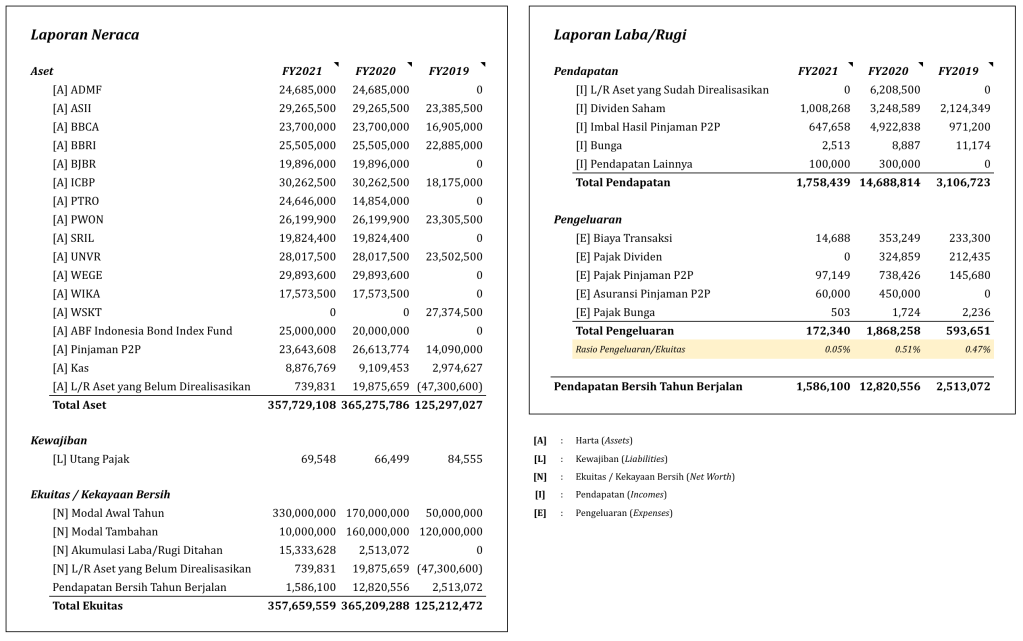
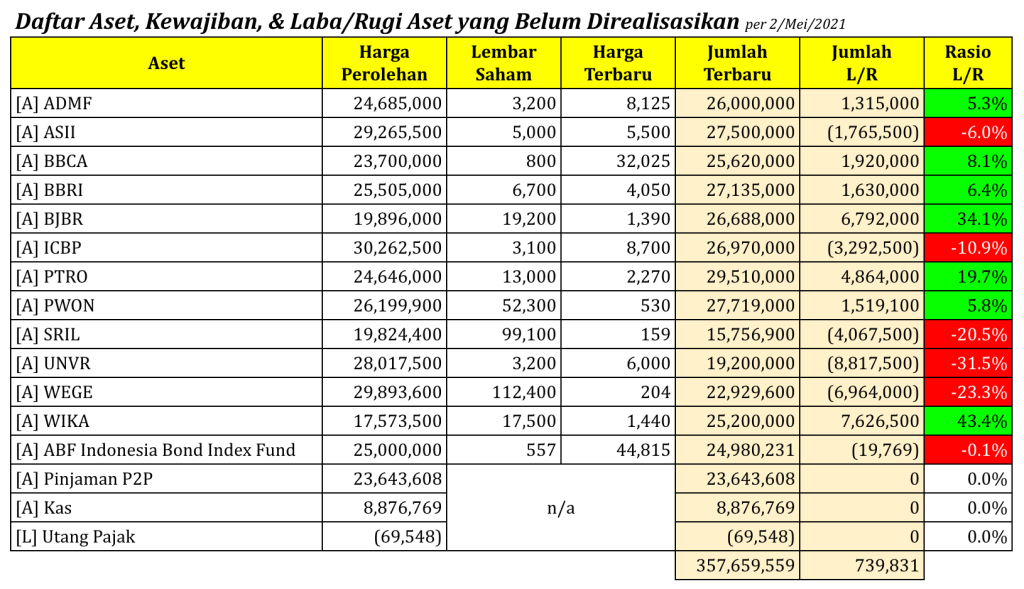
    Per akhir Minggu ke-109 (2 Mei 2021), nilai total portofolio kami naik sebesar Rp +1,717,985 (+0.48% dari minggu sebelumnya) menjadi Rp 357,659,559. Berikut detailnya :

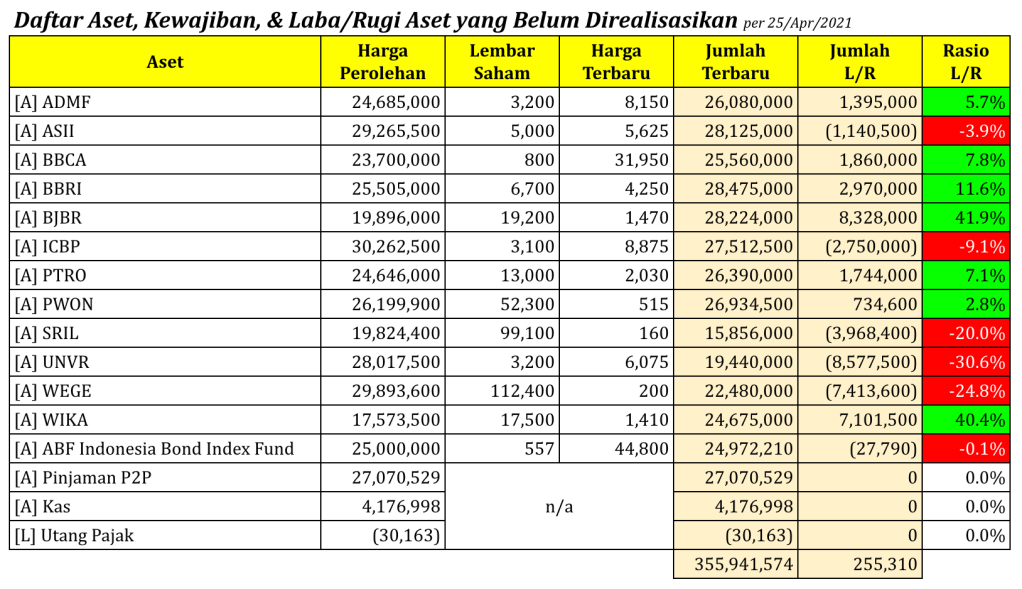
    Laba/Rugi Aset yang Belum Direalisasikan (naik Rp +484,521)

    • ADMF turun Rp -80,000
    • ASII turun Rp -625,000
    • BBCA naik Rp +60,000
    • BBRI turun Rp -1,340,000
    • BJBR turun Rp -1,536,000
    • ICBP turun Rp -542,500
    • PTRO naik Rp +3,120,000
    • PWON naik Rp +784,500
    • SRIL turun Rp -99,100
    • UNVR turun Rp -240,000
    • WEGE naik Rp +449,600
    • WIKA naik Rp +525,000
    • ABF Indonesia Bond Index Fund naik Rp +8,021

    Dividen Saham (naik Rp +1,008,268)

    • Dividen BBCA 800 lembar x Rp 432 = Rp +345,600
    • Dividen BBRI 6,700 x Rp 98.906 = Rp +662,668

    Pinjaman P2P (naik Rp +223,185)

    • Imbal hasil pinjaman P2P sebesar Rp +262,571
    • Pajak atas imbal hasil pinjaman P2P sebesar Rp -39,386

    Lainnya (naik Rp +2,010)

    • Bunga dari kas mengendap Rp +2,513
    • Pajak atas bunga dari kas mengendap Rp -503

    Terkait pajak atas imbal hasil yang didapat dari pinjaman P2P setiap minggunya, akan kami bukukan terlebih dahulu sebagai utang dan kami lunasi sesuai tenggat waktu di bulan berikutnya.

    Daftar Aset, Kewajiban, & Laba/Rugi Saham yang Belum Direalisasikan per tanggal 2 Mei 2021

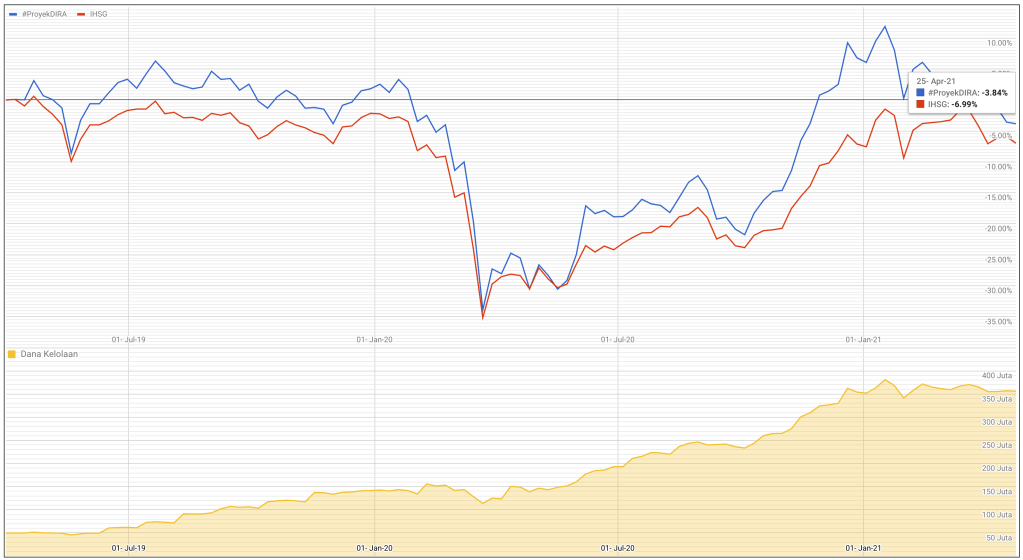
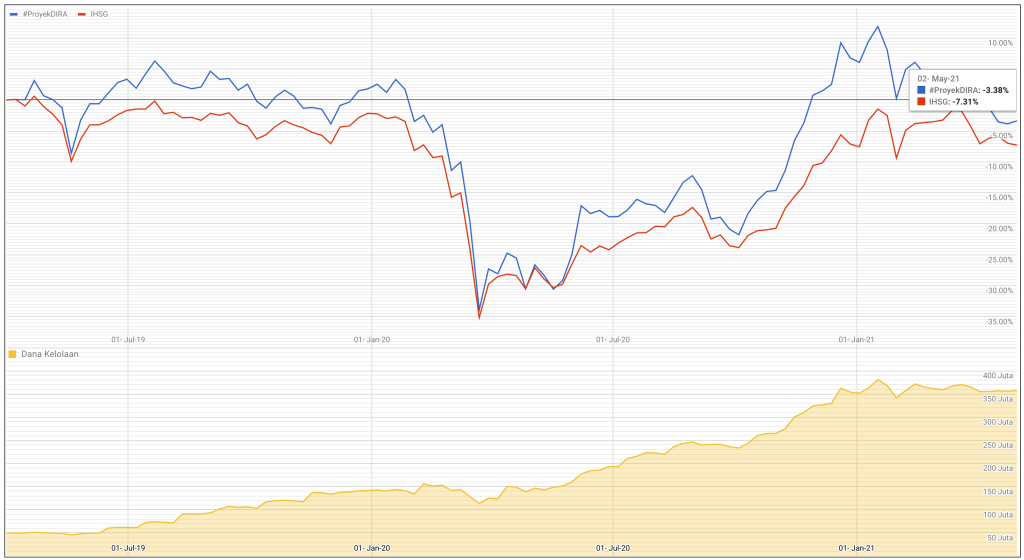
    Bursa saham secara keseluruhan melemah, dengan IHSG turun ke angka 5,995.62 (-0.35% dari minggu sebelumnya). Dihitung sejak kami memulai #ProyekDIRA ini (awal April 2019), performa overall portofolio kami turun -3.38%, sedikit lebih baik dari IHSG yang turun -7.31% pada periode yang sama.

    Perbandingan Performa Historis #ProyekDIRA vs IHSG sampai tanggal 2 Mei 2021

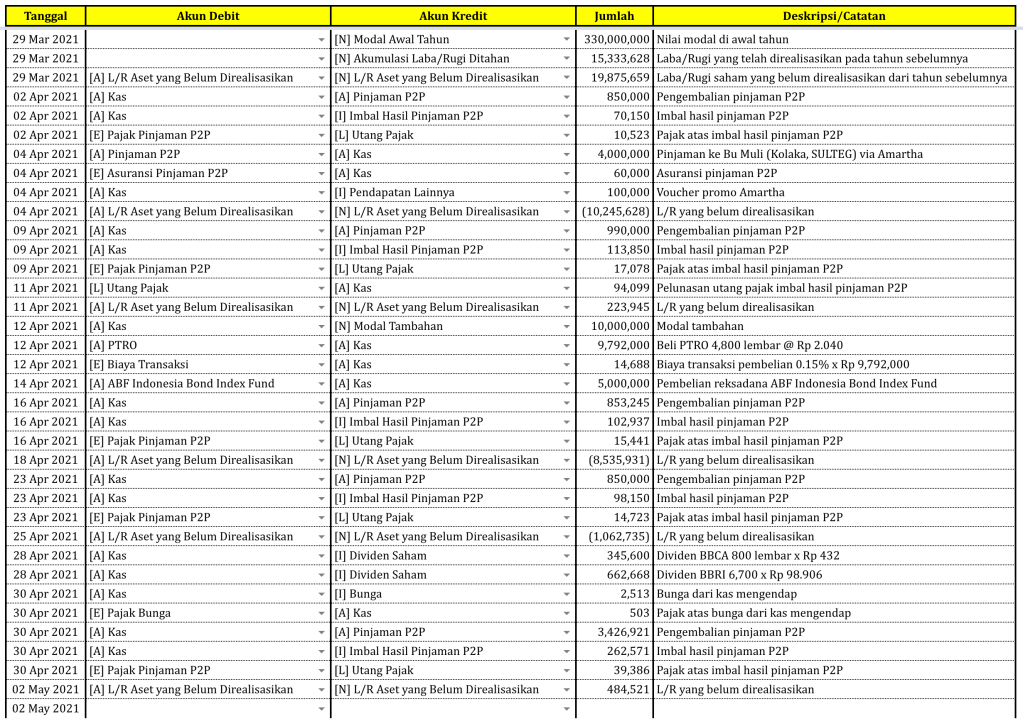
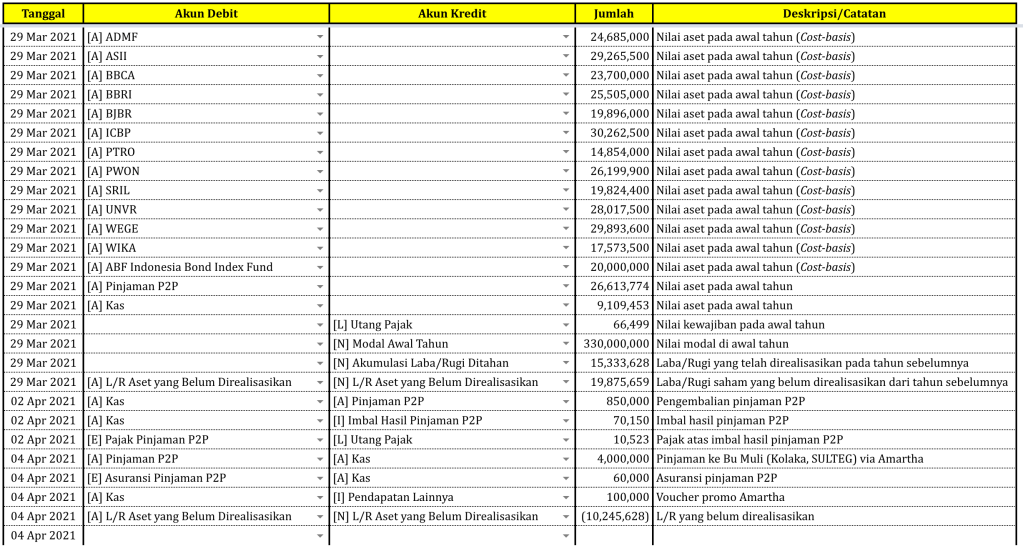
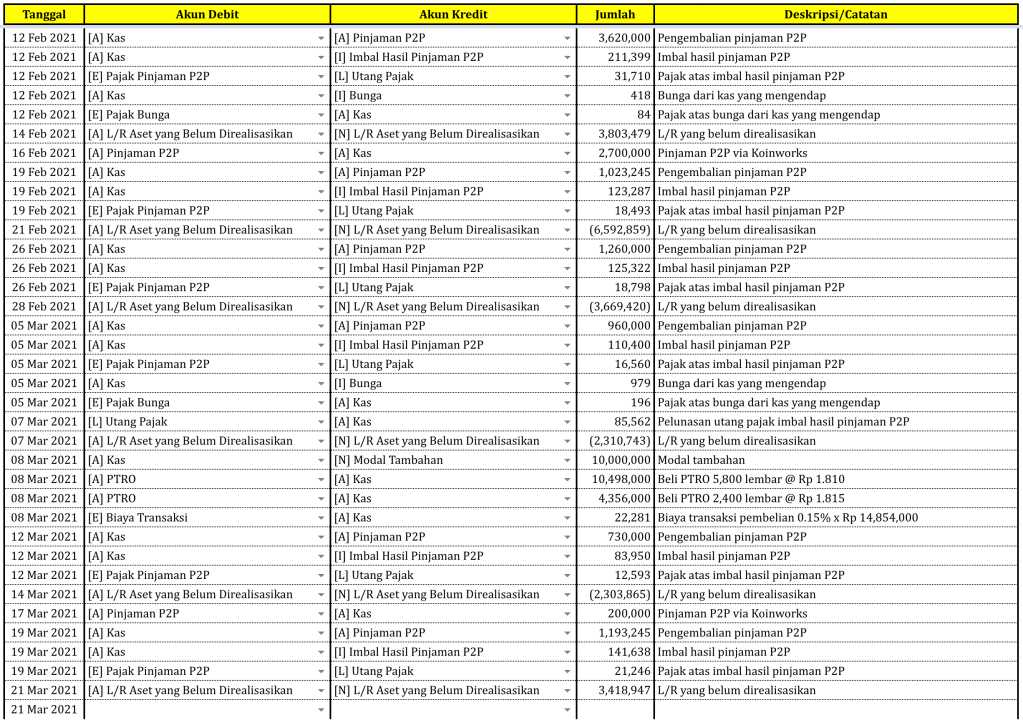
    Berikut Laporan Neraca, Laporan Laba/Rugi, serta Catatan Transaksi yang telah diperbaharui. Laporan tersebut juga dapat diakses dalam format Google Sheets di sini.

    Laporan Neraca & Laba/Rugi per tanggal 2 Mei 2021
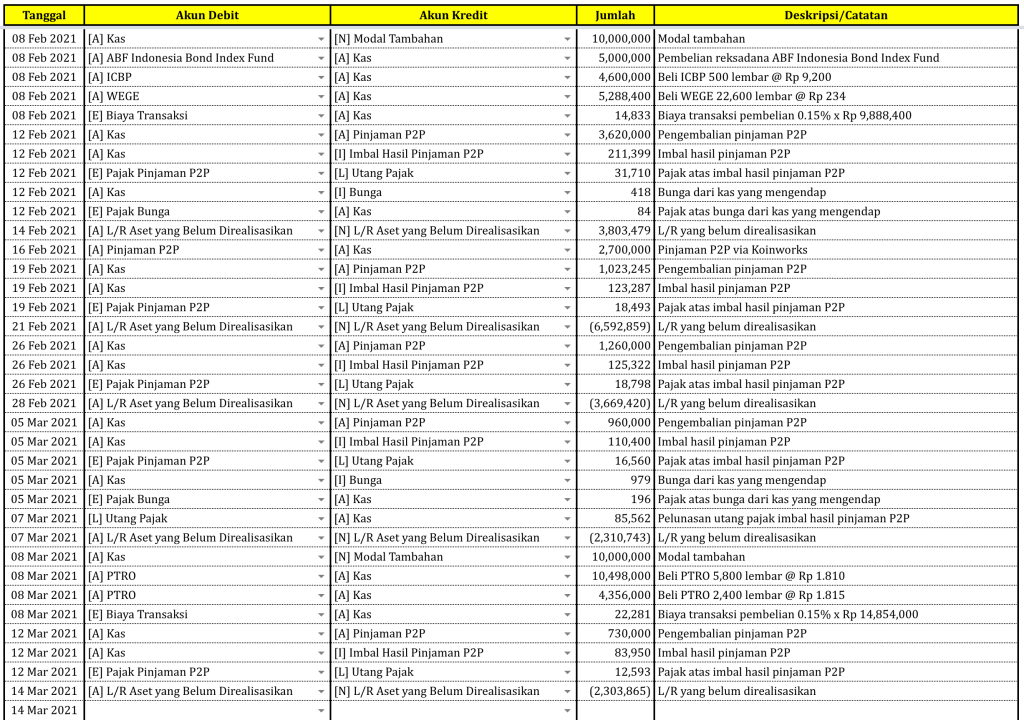
    Catatan Transaksi sampai tanggal 2 Mei 2021

    Minggu ini adalah minggu terakhir kami memberikan update #ProyekDIRA secara publik. Ke depannya, kami akan kelola portofolio kami secara privat.

    Mohon maaf karena banyak sekali kekurangan pada pengelolaan portofolio ini. Terima kasih banyak kepada teman-teman yang sudah berkenan membaca update dari kami setiap minggunya.


    Rizka & Ardhi

  • #ProyekDIRA | Minggu Ke-108

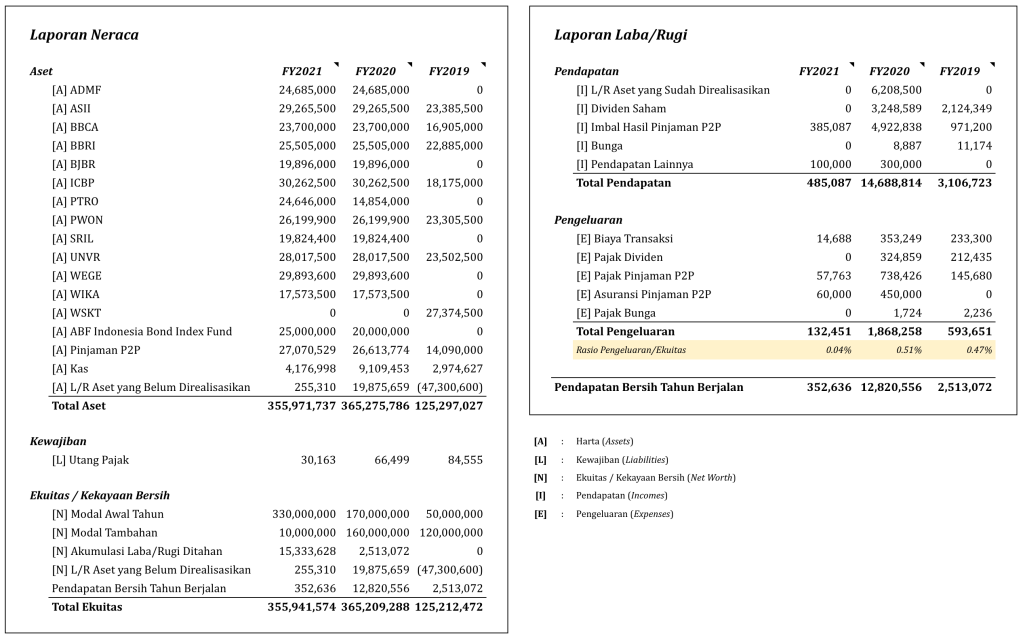
    Per akhir Minggu ke-108 (25 April 2021), nilai total portofolio kami turun sebesar Rp -979,307 (-0.27% dari minggu sebelumnya) menjadi Rp 355,941,574. Berikut detailnya :

    Laba/Rugi Aset yang Belum Direalisasikan (turun Rp -1,062,735)

    • ADMF turun Rp -320,000
    • ASII naik Rp +1,875,000
    • BBCA naik Rp +460,000
    • BBRI turun Rp -603,000
    • BJBR turun Rp -384,000
    • ICBP turun Rp -232,500
    • PTRO naik Rp +260,000
    • PWON naik Rp +523,000
    • SRIL turun Rp -2,081,100
    • UNVR turun Rp -800,000
    • WEGE turun Rp -224,800
    • WIKA naik Rp +350,000
    • ABF Indonesia Bond Index Fund naik Rp +114,665

    Pinjaman P2P (naik Rp +83,427)

    • Imbal hasil pinjaman P2P sebesar Rp +98,150
    • Pajak atas imbal hasil pinjaman P2P sebesar Rp -14,723

    Terkait pajak atas imbal hasil yang didapat dari pinjaman P2P setiap minggunya, akan kami bukukan terlebih dahulu sebagai utang dan kami lunasi sesuai tenggat waktu di bulan berikutnya.

    Daftar Aset, Kewajiban, & Laba/Rugi Saham yang Belum Direalisasikan per tanggal 25 April 2021

    Bursa saham secara keseluruhan melemah, dengan IHSG turun ke angka 6,016.86 (-1.14% dari minggu sebelumnya). Dihitung sejak kami memulai #ProyekDIRA ini (awal April 2019), performa overall portofolio kami turun -3.84%, sedikit lebih baik dari IHSG yang turun -6.99% pada periode yang sama.

    Perbandingan Performa Historis #ProyekDIRA vs IHSG sampai tanggal 25 April 2021

    Berikut Laporan Neraca, Laporan Laba/Rugi, serta Catatan Transaksi yang telah diperbaharui. Laporan tersebut juga dapat diakses dalam format Google Sheets di sini.

    Laporan Neraca & Laba/Rugi per tanggal 25 April 2021
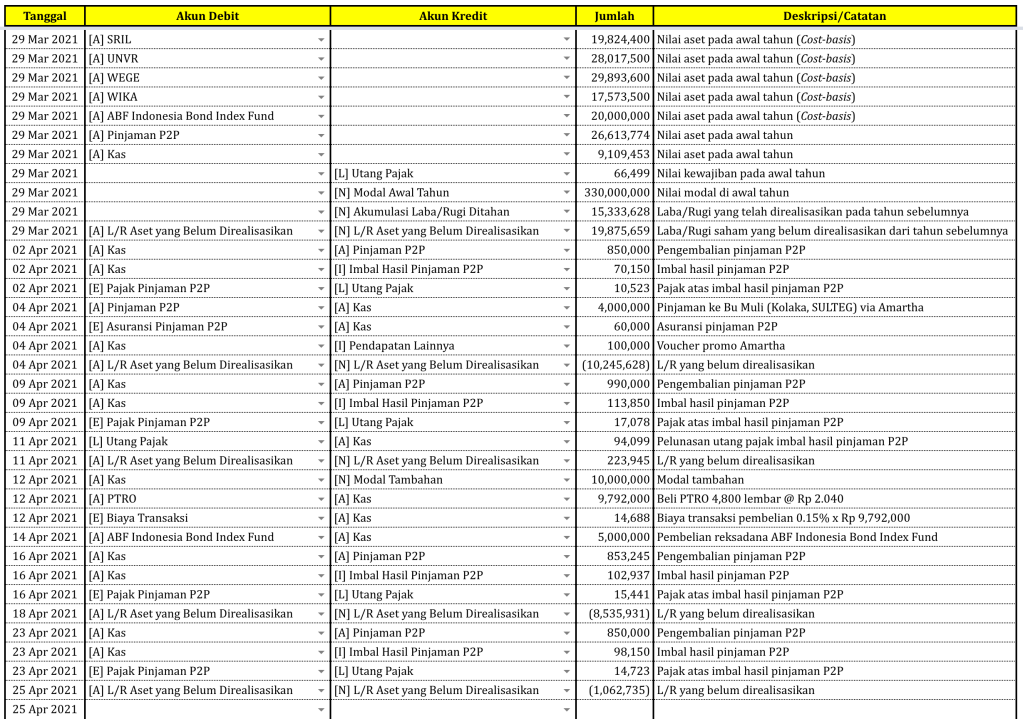
    Catatan Transaksi sampai tanggal 25 April 2021

    Rizka & Ardhi

  • #ProyekDIRA | Minggu Ke-107


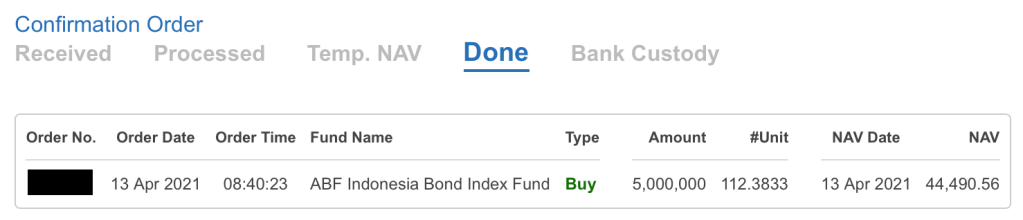
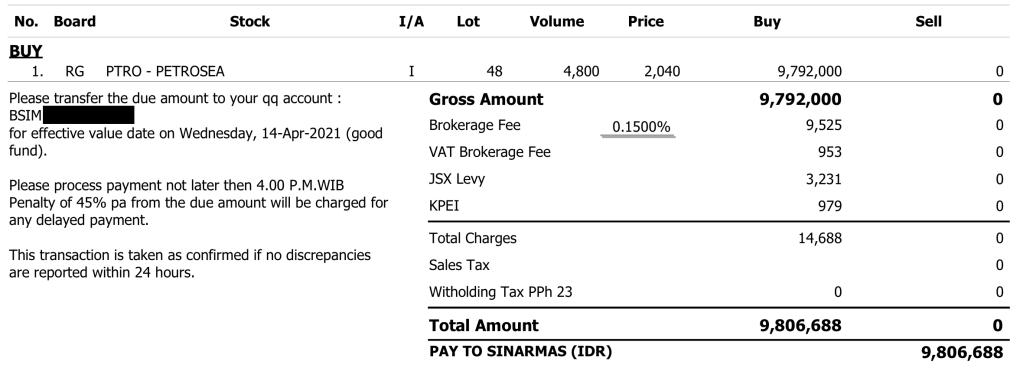
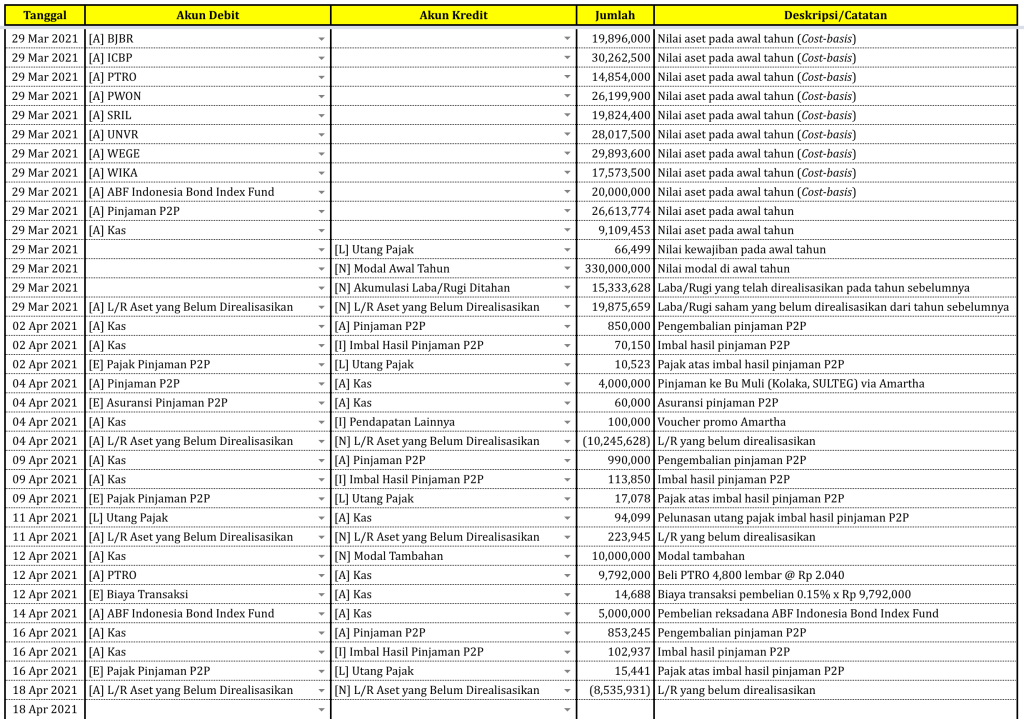
    Sebelum melaporkan posisi portofolio per akhir pekan ini, berikut laporan transaksi yang kami lakukan setelah memasukkan modal tambahan di awal pekan lalu.

    • Beli reksa dana ABF Indonesia Bond Fund Index Fund sebesar Rp 5,000,000
    • Beli 4,800 lembar saham PTRO pada harga Rp 2,040 dengan total Rp 9,792,000

    Atas pembelian saham PTRO tersebut dikenakan biaya transaksi sebesar Rp 14,688.

    Pembelian Reksa Dana ABF Indonesia Bond Index Fund
    Pembelian Saham PTRO

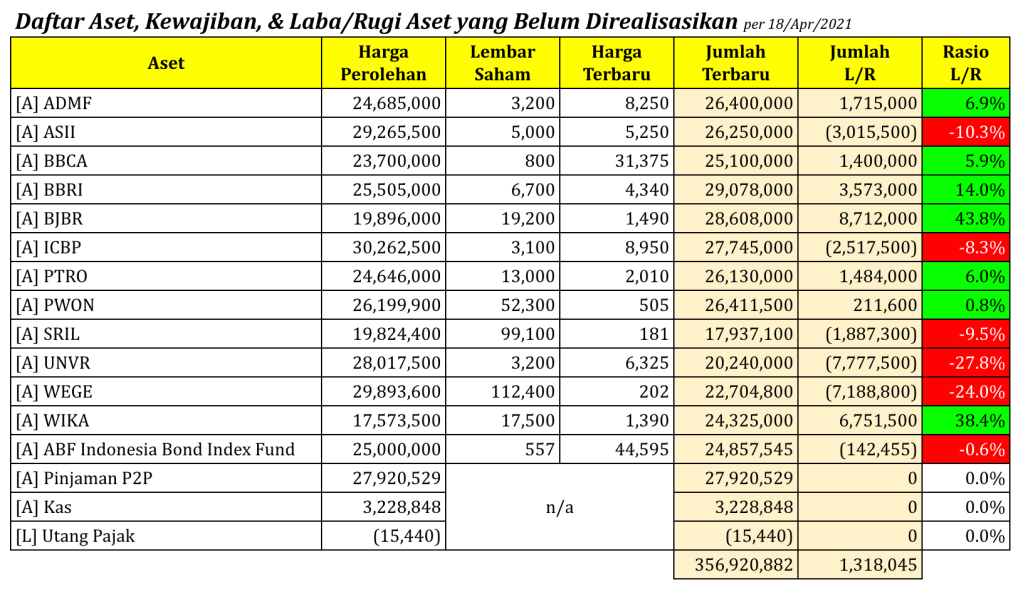
    Per akhir Minggu ke-107 (18 April 2021), nilai total portofolio kami turun sebesar Rp -8,463,122 (-2.32% dari minggu sebelumnya) menjadi Rp 356,920,882. Berikut detailnya :

    Laba/Rugi Aset yang Belum Direalisasikan (turun Rp -8,535,931)

    • ADMF turun Rp -480,000
    • ASII turun Rp -125,000
    • BBCA naik Rp +300,000
    • BBRI turun Rp -67,000
    • BJBR turun Rp -2,112,000
    • ICBP naik Rp +232,500
    • PTRO turun Rp -636,000
    • PWON turun Rp -1,569,000
    • SRIL turun Rp -1,486,500
    • UNVR turun Rp -480,000
    • WEGE turun Rp -674,400
    • WIKA turun Rp -1,400,000
    • ABF Indonesia Bond Index Fund turun Rp -38,531

    Pinjaman P2P (naik Rp +87,496)

    • Imbal hasil pinjaman P2P sebesar Rp +102,937
    • Pajak atas imbal hasil pinjaman P2P sebesar Rp -15,441

    Lainnya (turun Rp -14,688)

    • Biaya transaksi pembelian saham PTRO sebesar Rp -14,688

    Terkait pajak atas imbal hasil yang didapat dari pinjaman P2P setiap minggunya, akan kami bukukan terlebih dahulu sebagai utang dan kami lunasi sesuai tenggat waktu di bulan berikutnya.

    Daftar Aset, Kewajiban, & Laba/Rugi Saham yang Belum Direalisasikan per tanggal 18 April 2021

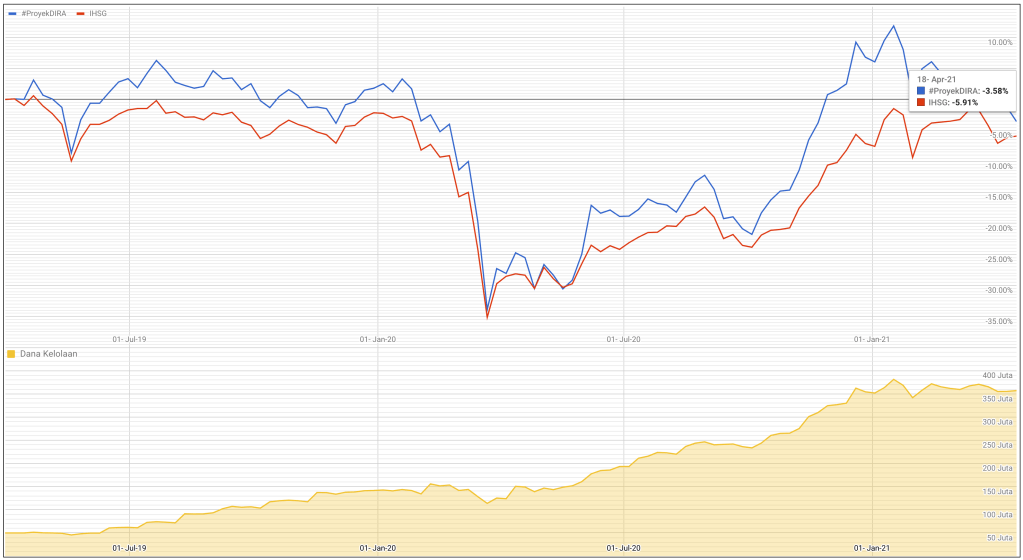
    Bursa saham secara keseluruhan menguat, dengan IHSG naik ke angka 6,086.26 (+0.26% dari minggu sebelumnya). Dihitung sejak kami memulai #ProyekDIRA ini (awal April 2019), performa overall portofolio kami turun -3.58%, sedikit lebih baik dari IHSG yang turun -5.91% pada periode yang sama.

    Perbandingan Performa Historis #ProyekDIRA vs IHSG sampai tanggal 18 April 2021

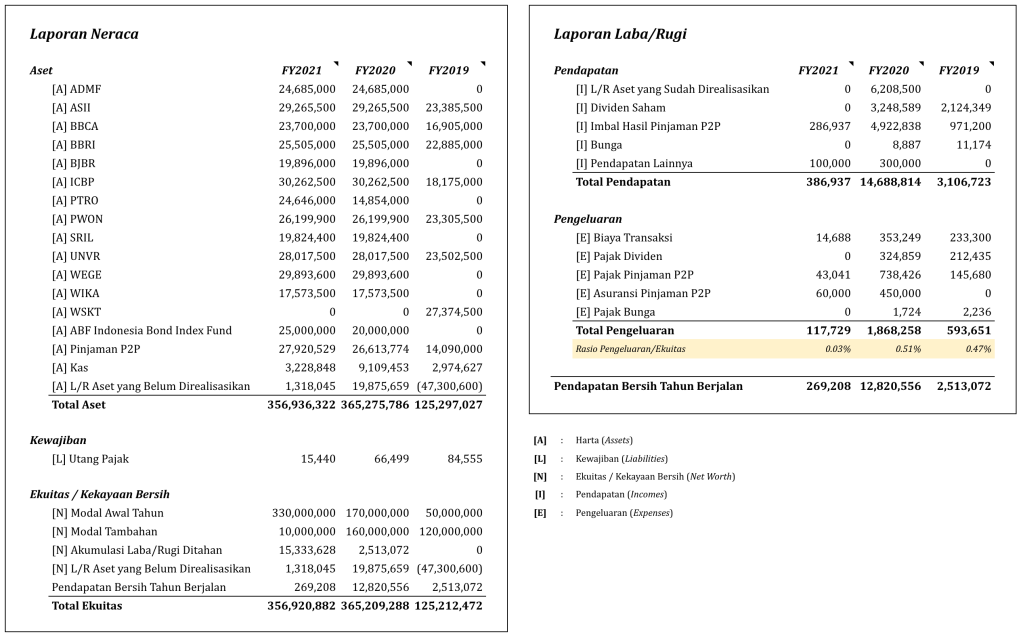
    Berikut Laporan Neraca, Laporan Laba/Rugi, serta Catatan Transaksi yang telah diperbaharui. Laporan tersebut juga dapat diakses dalam format Google Sheets di sini.

    Laporan Neraca & Laba/Rugi per tanggal 18 April 2021
    Catatan Transaksi sampai tanggal 18 April 2021

    Rizka & Ardhi

  • #ProyekDIRA | Minggu Ke-106


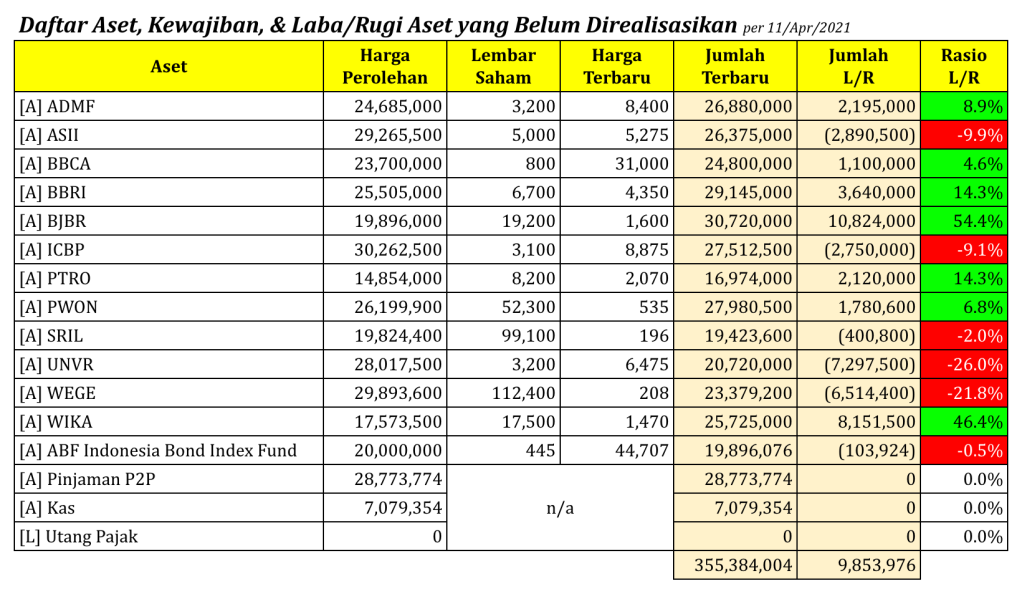
    Per akhir Minggu ke-106 (11 April 2021), nilai total portofolio kami naik sebesar Rp +320,717 (+0.09% dari minggu sebelumnya) menjadi Rp 355,384,004. Berikut detailnya :

    Laba/Rugi Aset yang Belum Direalisasikan (naik Rp +223,945)

    • ADMF naik Rp +240,000
    • ASII turun Rp -375,000
    • BBCA turun Rp -100,000
    • BBRI naik Rp +402,000
    • BJBR naik Rp +1,344,000
    • ICBP turun Rp -232,500
    • PTRO naik Rp +1,148,000
    • PWON turun Rp -261,500
    • SRIL turun Rp -792,800
    • UNVR turun Rp -480,000
    • WEGE naik Rp +224,800
    • WIKA turun Rp -1,137,500
    • ABF Indonesia Bond Index Fund naik Rp +244,445

    Pinjaman P2P (naik Rp +99,628)

    • Imbal hasil pinjaman P2P sebesar Rp +113,850
    • Pajak atas imbal hasil pinjaman P2P sebesar Rp -17,078

    Utang pajak atas imbal hasil dari pinjaman P2P di bulan Maret sebesar Rp 94,099 juga telah kami lunasi.

    Daftar Aset, Kewajiban, & Laba/Rugi Saham yang Belum Direalisasikan per tanggal 11 April 2021

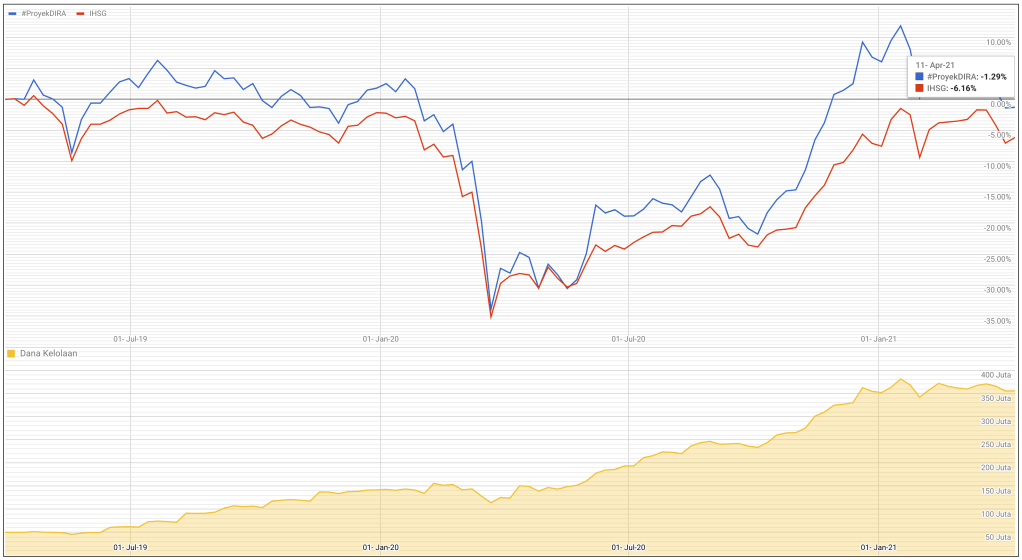
    Bursa saham secara keseluruhan menguat, dengan IHSG naik ke angka 6,070.21 (+0.98% dari minggu sebelumnya). Dihitung sejak kami memulai #ProyekDIRA ini (awal April 2019), performa overall portofolio kami turun -1.29%, sedikit lebih baik dari IHSG yang turun -6.16% pada periode yang sama.

    Perbandingan Performa Historis #ProyekDIRA vs IHSG sampai tanggal 11 April 2021

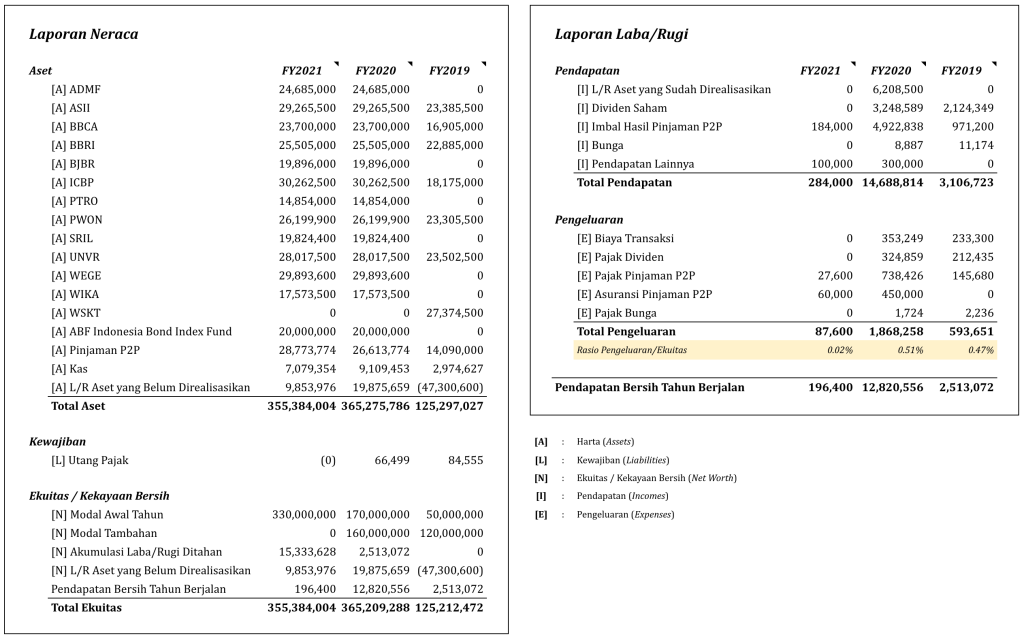
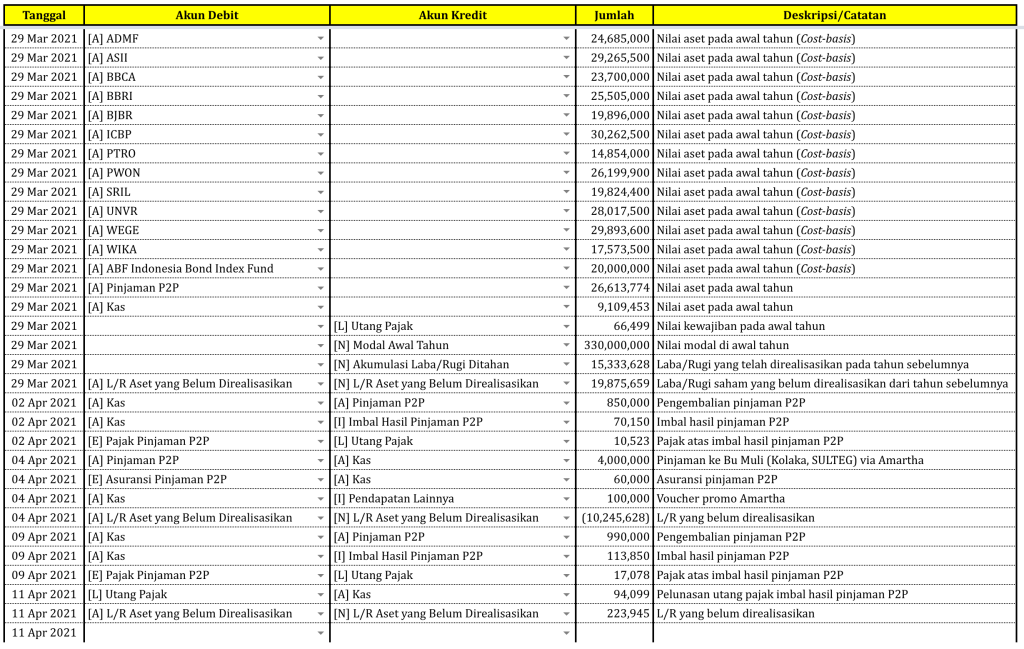
    Berikut Laporan Neraca, Laporan Laba/Rugi, serta Catatan Transaksi yang telah diperbaharui. Laporan tersebut juga dapat diakses dalam format Google Sheets di sini.

    Laporan Neraca & Laba/Rugi per tanggal 11 April 2021
    Catatan Transaksi sampai tanggal 11 April 2021

    Setelah menyelesaikan berbagai kewajiban di awal bulan, kami dapat menyisihkan dana tambahan sebesar 10 juta Rupiah untuk diinvestasikan. Rencananya seluruh dana tersebut akan kami alokasikan untuk membeli saham.


    Rizka & Ardhi

  • #ProyekDIRA | Minggu Ke-105


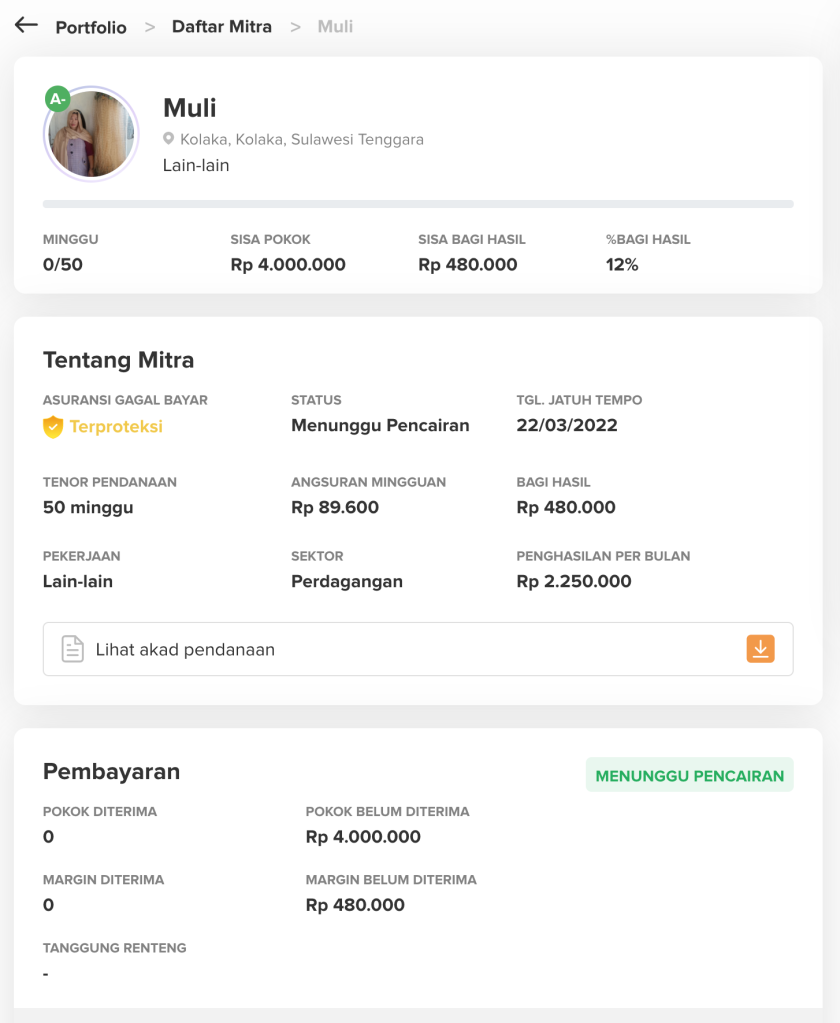
    Sebelum melaporkan posisi portofolio per akhir pekan ini, berikut laporan transaksi penyaluran pinjaman P2P via Amartha kepada Ibu Muli di Kolaka, Sulawesi Tenggara pada tanggal 4 April. Status pinjaman saat ini masih menunggu pencairan.

    Status pinjaman via Amartha

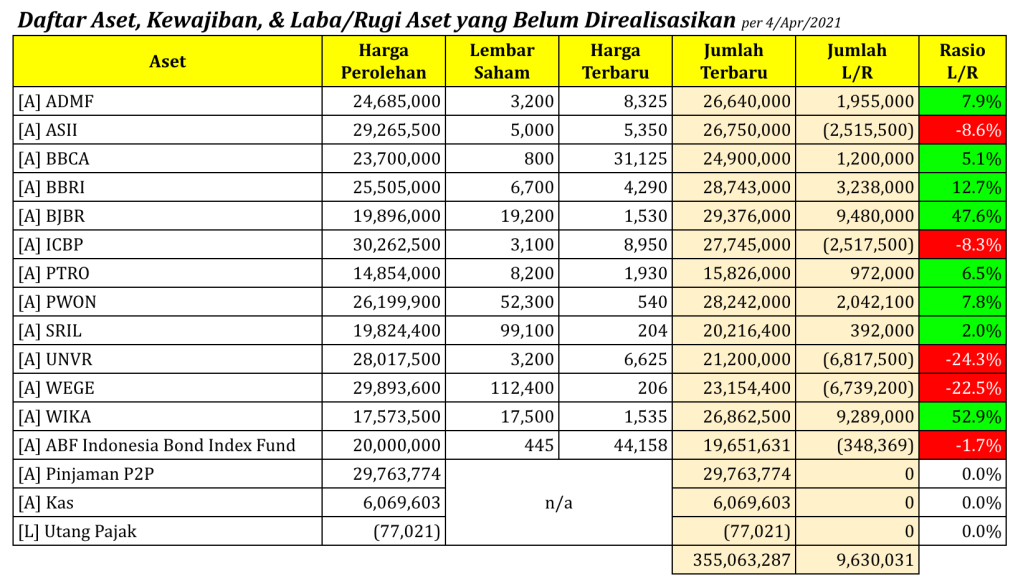
    Per akhir Minggu ke-105 (4 April 2021), nilai total portofolio kami turun sebesar Rp -10,146,001 (-2.78% dari minggu sebelumnya) menjadi Rp 355,063,287. Berikut detailnya :

    Laba/Rugi Aset yang Belum Direalisasikan (turun Rp -10,245,628)

    • ADMF turun Rp -560,000
    • ASII turun Rp -1,250,000
    • BBCA turun Rp -760,000
    • BBRI turun Rp -2,881,000
    • BJBR turun Rp -192,000
    • ICBP turun Rp -465,000
    • PTRO naik Rp +574,000
    • PWON turun Rp -1,307,500
    • SRIL turun Rp -991,000
    • UNVR naik Rp +80,000
    • WEGE turun Rp -1,124,000
    • WIKA turun Rp -1,400,000
    • ABF Indonesia Bond Index Fund naik Rp +30,872

    Pinjaman P2P (naik Rp +99,628)

    • Imbal hasil pinjaman P2P sebesar Rp +70,150
    • Pajak atas imbal hasil pinjaman P2P sebesar Rp -10,522
    • Asuransi pinjaman P2P sebesar Rp -60,000
    • Voucher promosi dari Amartha sebesar Rp +100,000

    Terkait pajak atas imbal hasil yang didapat dari pinjaman P2P setiap minggunya, akan kami bukukan terlebih dahulu sebagai utang dan kami lunasi sesuai tenggat waktu di bulan berikutnya.

    Daftar Aset, Kewajiban, & Laba/Rugi Saham yang Belum Direalisasikan per tanggal 4 April 2021

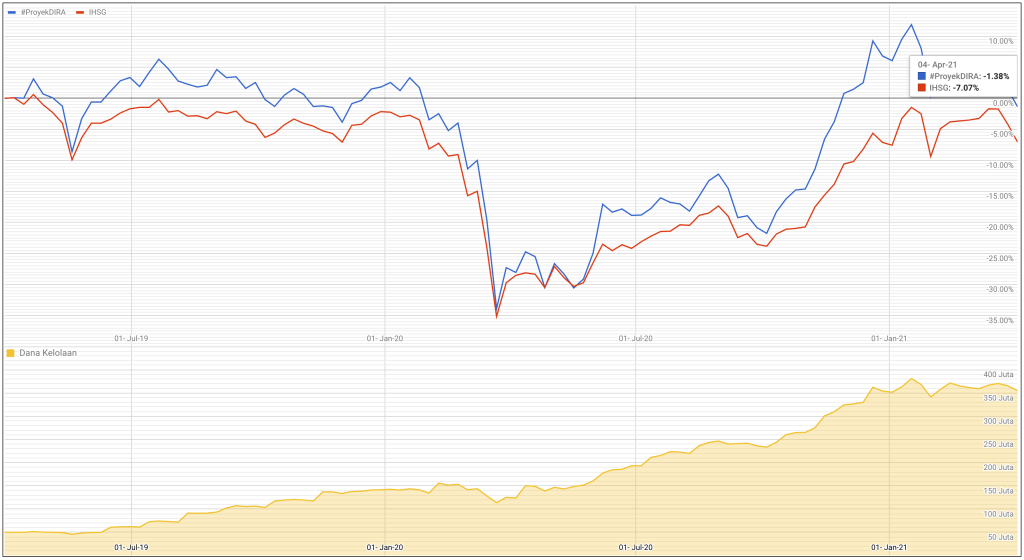
    Bursa saham secara keseluruhan melemah, dengan IHSG turun ke angka 6,011.46 (-2.97% dari minggu sebelumnya). Dihitung sejak kami memulai #ProyekDIRA ini (awal April 2019), performa overall portofolio kami turun -1.38%, sedikit lebih baik dari IHSG yang turun -7.07% pada periode yang sama.

    Perbandingan Performa Historis #ProyekDIRA vs IHSG sampai tanggal 4 April 2021

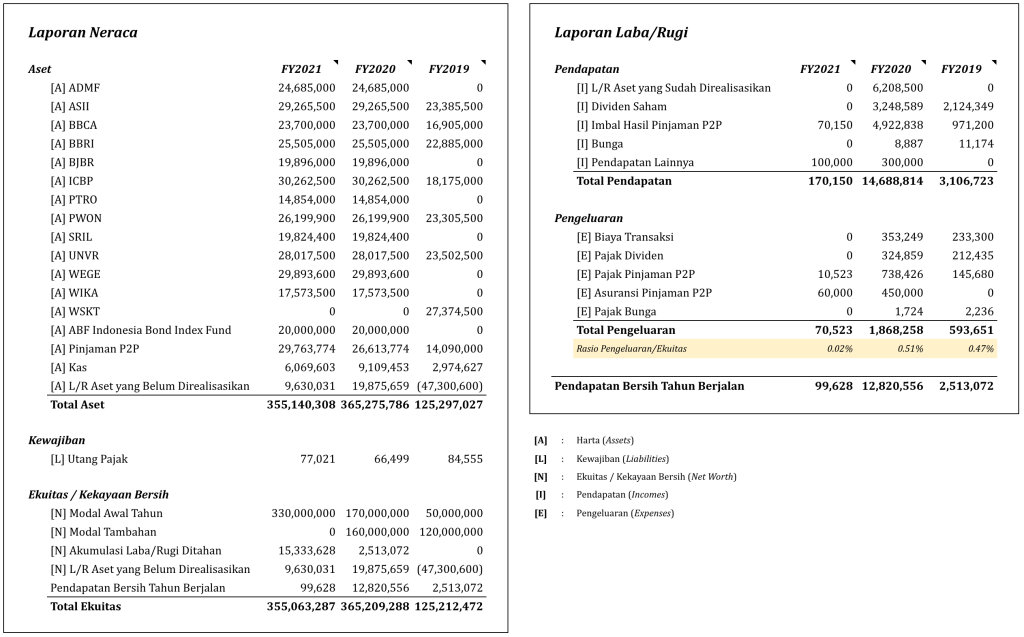
    Berikut Laporan Neraca, Laporan Laba/Rugi, serta Catatan Transaksi yang telah diperbaharui. Laporan tersebut juga dapat diakses dalam format Google Sheets di sini.

    Laporan Neraca & Laba/Rugi per tanggal 4 April 2021
    Catatan Transaksi sampai tanggal 4 April 2021

    Rizka & Ardhi

  • #ProyekDIRA | Laporan Akhir Tahun Ke-2 (Minggu Ke-104)


    Melihat Setahun ke Belakang

    Sudah 2 tahun sejak kami memulai #ProyekDIRA 104 minggu yang lalu. Setelah pasar saham anjlok cukup dalam di bulan Februari hingga Maret tahun lalu, kami memasuki tahun ke-2 dengan sedikit cemas, karena di tengah pandemi seperti ini, kami tidak hanya khawatir soal kerugian portofolio investasi kami, tapi juga adanya kemungkinan kehilangan pekerjaan dan penghasilan, mengingat cukup banyak perusahaan skala kecil sampai besar yang harus gulung tikar dan melepaskan semua karyawannya.

    Kami bersyukur karena di tengah situasi seperti ini, perusahaan tempat kami bekerja tidak sampai tutup, sehingga kami pun tidak sampai kehilangan pekerjaan. Kegiatan produksi di perusahaan tempat kami bekerja pun berangsur-angsur meningkat, meskipun belum sepenuhnya kembali ke level sebelum pandemi. Sempat ada kekhawatiran karena beberapa rekan kerja kami yang terinfeksi Covid-19. Namun kami beruntung memiliki rekan kerja yang peduli, yang selalu berupaya menjalankan protokol kesehatan (pakai masker, cuci tangan, jaga jarak) sehingga kami tidak sampai tertular dan masih sehat sampai sekarang.

    Tahun lalu kami memangkas cukup banyak pengeluaran (kami bahkan tidak mudik, dan membatalkan semua rencana wisata). Selama tahun fiskal 2020 kemarin, kami dapat menyisihkan dana sebesar160 juta Rupiah dari penghasilan bulanan kami untuk dimasukkan ke dalam portofolio #ProyekDIRA. Dengan ini, kami sudah memasukkan dana total sebesar 330 juta Rupiah selama 2 tahun. Sejauh ini belum ada keperluan mendesak yang memerlukan dana besar, sehingga kami pun belum menarik dana sepeserpun dari portofolio #ProyekDIRA.

    Dari 7 saham yang kami miliki per akhir tahun ke-1, kami sudah menjual saham WSKT. Tahun ini kami cukup aktif membeli saham baru, yakni ADMF, BJBR, PTRO, SRIL, WEGE, dan WIKA. Kami juga mulai investasi di obligasi melalui reksa dana ABF Indonesia Bond Index Fund (yang kami beli via IndoPremier) dan kami juga mulai menggunakan KoinWorks sebagai platform alternatif untuk pendanaan pinjaman P2P selain Amartha.

    Performa Investasi

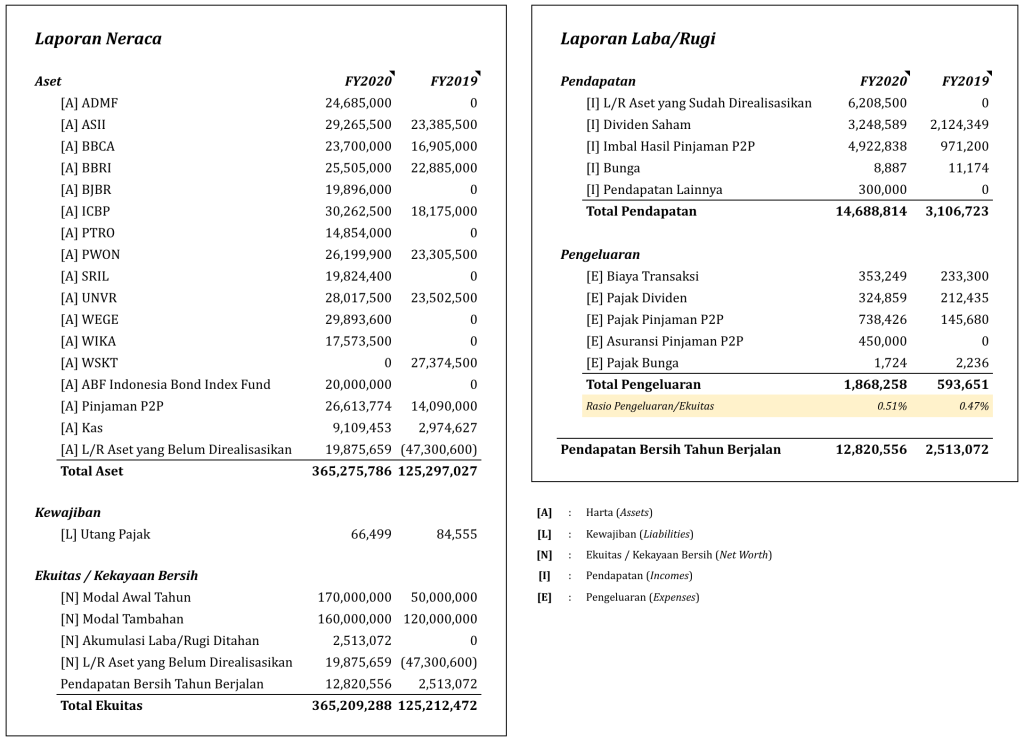
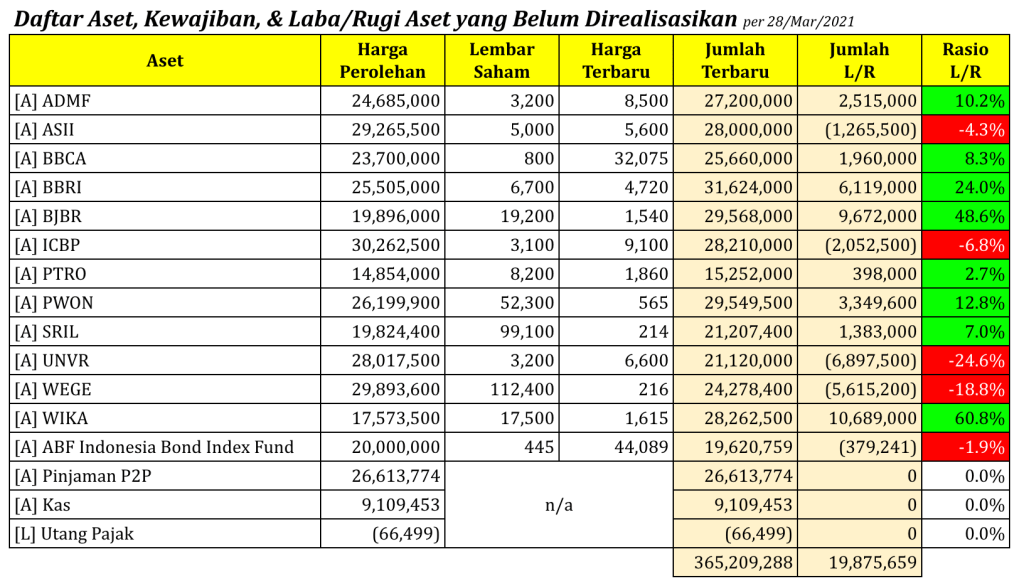
    Mari kita mulai dari saham terlebih dahulu. Tahun ini adalah tahun yang cukup baik bagi pasar saham, karena sebagian besar harga saham sudah kembali naik, bahkan beberapa saham sudah pulih dan naik lebih tinggi dari level sebelum pandemi kemarin. Selama tahun fiskal 2020 kemarin, kami mencatatkan kenaikan laba/rugi yang belum direalisasikan (unrealized gain/loss) sebesar Rp +67,176,259. Berikut rincian laba/rugi yang belum direalisasikan dari tiap emiten saham, termasuk reksadana ABF Indonesia Bond Index Fund (dibanding posisi per akhir tahun ke-1).

    • ADMF naik Rp +2,515,000
    • ASII naik Rp +7,840,000
    • BBCA naik Rp +2,335,000
    • BBRI naik Rp +10,593,000
    • BJBR naik Rp +9,672,000
    • ICBP turun Rp -1,832,500
    • PTRO naik Rp +398,000
    • PWON naik Rp +11,591,700
    • SRIL naik Rp +1,383,000
    • UNVR turun Rp -1,075,000
    • WEGE turun Rp -5,615,200
    • WIKA naik Rp +10,689,000
    • WSKT* naik Rp +19,061,500
    • ABF Indonesia Bond Index Fund turun Rp -379,241

    * Catatan terkait penjualan saham WSKT :

    Pada tahun fiskal 2020 kemarin, kami melakukan 2x pembelian saham WSKT untuk averaging down hingga terkumpul 27,600 lembar saham dengan nilai total pembelian Rp 34,777,500. Pada tanggal 18 Desember 2020, kami jual semua saham WSKT pada harga Rp 1,485, sehingga kami dapat memulihkan unrealized loss WSKT yang kami catatkan pada akhir tahun ke-1 (Rp +19,061,500) dan merealisasikan keuntungan (realized gain) sebesar Rp +6,208,500.

    Sepanjang tahun fiskal 2020 kemarin, kami menerima dividen sebesar Rp +3,248,589. Atas dividen tersebut, dikenakan pajak 10% atau sebesar Rp -324,859. Berikut rinciannya.

    • Dari saham ASII sebesar Rp +920,000
    • Dari saham BBCA sebesar Rp +331,800
    • Dari saham ICBP sebesar Rp +451,500
    • Dari saham SRIL sebesar Rp +53,800
    • Dari saham UNVR sebesar Rp +504,400
    • Dari saham WIKA sebesar Rp +891,712
    • Dari saham WSKT sebesar Rp +95,377

    Kegiatan ekonomi yang mulai berangsur pulih juga nampak dari performa penerima pinjaman P2P. Setelah beberapa kali tersendat di pertengahan tahun 2020 kemarin, beberapa penerima pinjaman sudah kembali lancar membayarkan pokok & bunga pinjaman. Total selama tahun fiskal 2020 kemarin, kami menerima imbal hasil dari pinjaman P2P (via Amartha & KoinWorks) sebesar Rp +4,922,838. Atas imbal hasil tersebut dikenakan pajak 15% atau sebesar Rp -738,426.

    Pendapatan dan biaya lainnya yang kami terima dan bayarkan selama tahun fiskal 2020 kemarin antara lain :

    • Biaya transaksi beli/jual saham sebesar Rp -353,249
    • Pendapatan lainnya berupa voucher promo dari Amartha sebesar Rp +300,000
    • Biaya asuransi pinjaman P2P via Amartha sebesar Rp -450,000
    • Pendapatan bunga dari kas yang mengendap sebesar Rp +8,887
    • Pajak atas bunga dari kas yang mengendap sebesar Rp -1,724

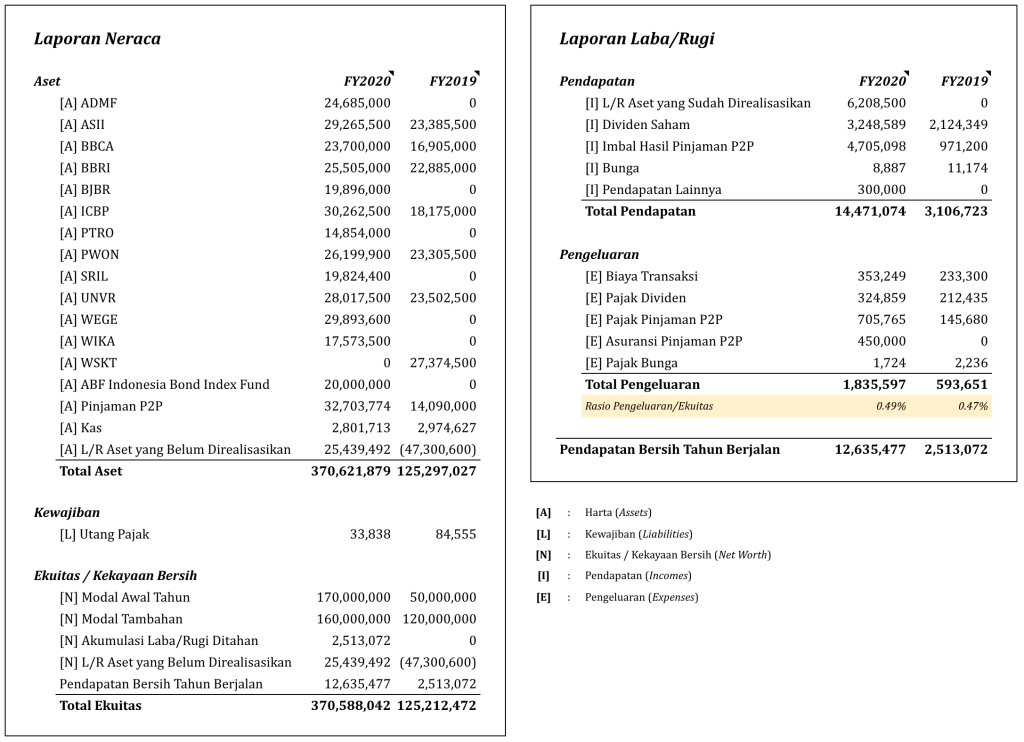
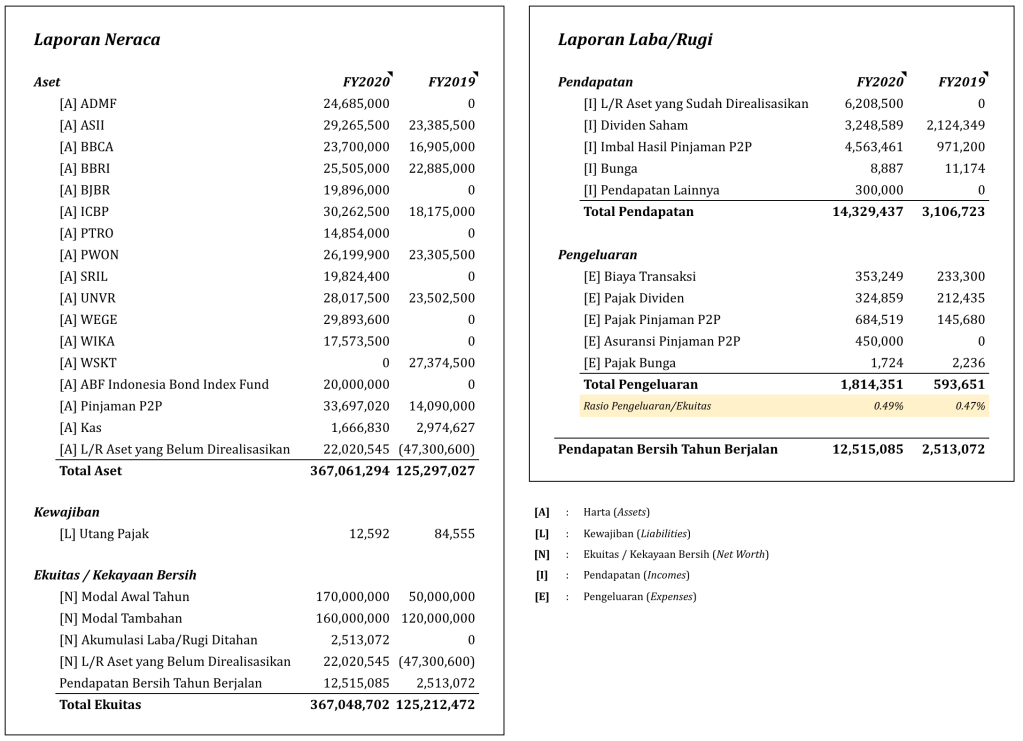
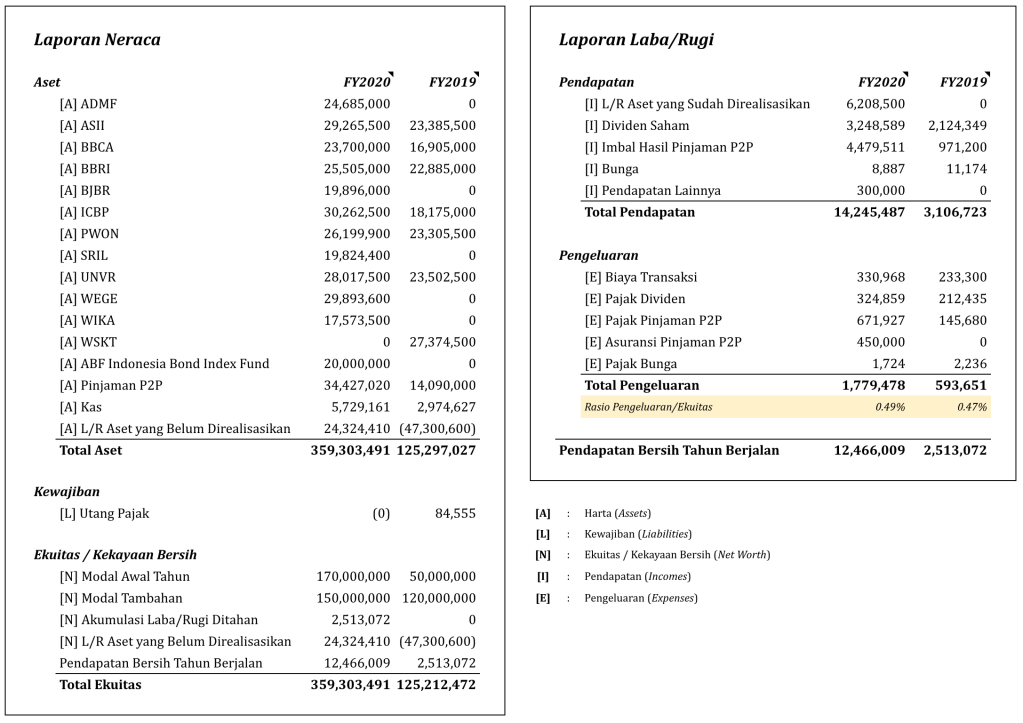
    Berikut Laporan Neraca, Laporan Laba/Rugi, serta Daftar Aset, Kewajiban, & Laba/Rugi Saham yang Belum Direalisasikan sampai tanggal 28 Maret 2021. Laporan tersebut juga dapat diakses dalam format Google Sheets di sini.

    Laporan Neraca & Laba/Rugi per tanggal 28 Maret 2021
    Daftar Aset, Kewajiban, & Laba/Rugi Saham yang Belum Direalisasikan per tanggal 28 Maret 2021

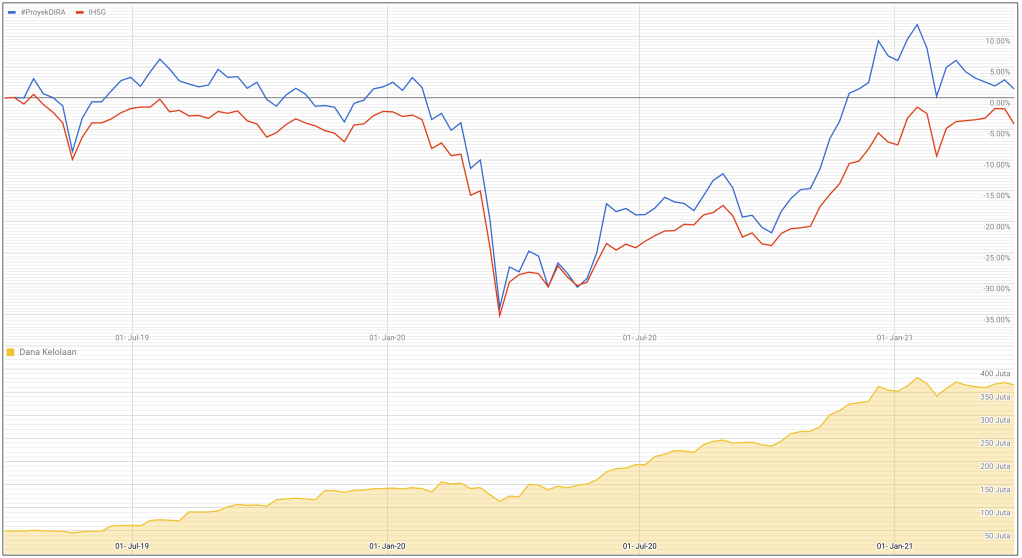
    Kami menggunakan IHSG sebagai acuan, semata-mata karena sebagian besar modal kami diinvestasikan pada instrumen saham. Dengan mengacu pada IHSG, kami bisa melihat bagaimana tren pasar saham secara umum untuk memahami fluktuasi pada nilai portofolio kami sendiri.

    Dihitung sejak kami memulai #ProyekDIRA ini (awal April-2019), performa overall portofolio kami naik +1.44%, sedikit unggul di atas IHSG yang turun -4.22% pada periode yang sama. Namun perlu dicatat bahwa performa IHSG tersebut belum termasuk dividen.

    Perbandingan Performa Historis #ProyekDIRA vs IHSG sampai tanggal 21 Maret 2021

    Melihat Ke Depan

    Salah satu mental model yang sering saya ingat adalah Mean reversion. Apapun itu yang terlalu ekstrem, akan kembali ke kondisi rerata normalnya. Seperti halnya saham, yang jatuh anjlok akan naik kembali, dan yang melambung tinggi pun akan turun kembali. Seperti disampaikan oleh Abraham Lincoln :
    It is said an Eastern monarch once charged his wise men to invent him a sentence to be ever in view, and which should be true and appropriate in all times and situations. They presented him the words, “And this, too, shall pass away.” How much it expresses! How chastening in the hour of pride! How consoling in the depths of affliction! “And this, too, shall pass away.” And yet, let us hope, it is not quite true. Let us hope, rather, that by the best cultivation of the physical world beneath and around us, and the intellectual and moral world within us, we shall secure an individual, social, and political prosperity and happiness, whose course shall be onward and upward, and which, while the earth endures, shall not pass away.

    Meskipun belum sepenuhnya pulih, namun kita bisa berharap bahwa kondisi ini akan segera selesai. Jumlah kasus positif baru dan jumlah pasien aktif berangsur turun, dan jumlah peserta vaksinasi harian terlihat sangat menjanjikan. Semoga rekan-rekan yang sempat kehilangan pekerjaan, terpaksa menutup kegiatan usahanya, atau yang tidak bisa pulang bertemu dengan keluarga, dapat kembali bekerja, berusaha, dan bertemu dengan keluarga.

    Rizka & Ardhi

  • #ProyekDIRA | Minggu Ke-103


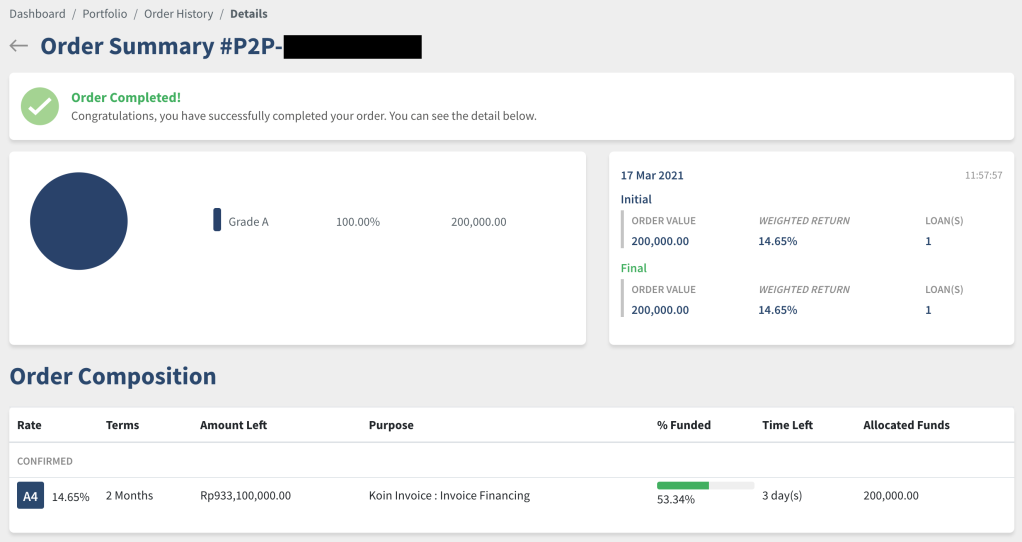
    Sebelum melaporkan posisi portofolio per akhir pekan ini, berikut transaksi penyaluran pinjaman P2P via KoinWorks pada tanggal 17 Maret kemarin. Transaksi ini dilakukan secara otomatis menggunakan fitur Auto-Purchase dari KoinWorks.

    Status pinjaman P2P via KoinWorks

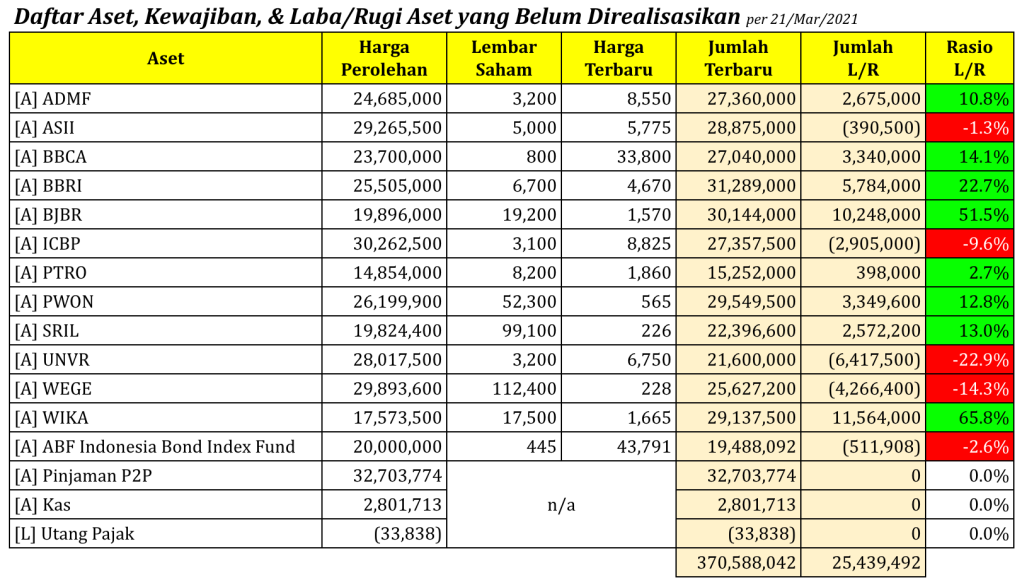
    Per akhir Minggu ke-103 (21 Maret 2021), nilai total portofolio kami naik sebesar Rp +3,539,339 (+0.96% dari minggu sebelumnya) menjadi Rp 370,588,042. Berikut detailnya :

    Laba/Rugi Aset yang Belum Direalisasikan (naik Rp +3,418,947)

    • ADMF naik Rp +640,000
    • ASII naik Rp +1,500,000
    • BBCA turun Rp -20,000
    • BBRI naik Rp +603,000
    • BJBR naik Rp +672,000
    • ICBP naik Rp +1,395,000
    • PTRO naik Rp +328,000
    • PWON turun Rp -1,830,500
    • UNVR naik Rp +160,000
    • WEGE turun Rp -449,600
    • WIKA naik Rp +437,500
    • ABF Indonesia Bond Index Fund turun Rp -16,453

    Pinjaman P2P (naik Rp +120,392)

    • Imbal hasil pinjaman P2P sebesar Rp +141,638
    • Pajak atas imbal hasil pinjaman P2P sebesar Rp -21,246

    Terkait pajak atas imbal hasil yang didapat dari pinjaman P2P setiap minggunya, akan kami bukukan terlebih dahulu sebagai utang dan kami lunasi sesuai tenggat waktu di bulan berikutnya.

    Daftar Aset, Kewajiban, & Laba/Rugi Saham yang Belum Direalisasikan per tanggal 21 Maret 2021

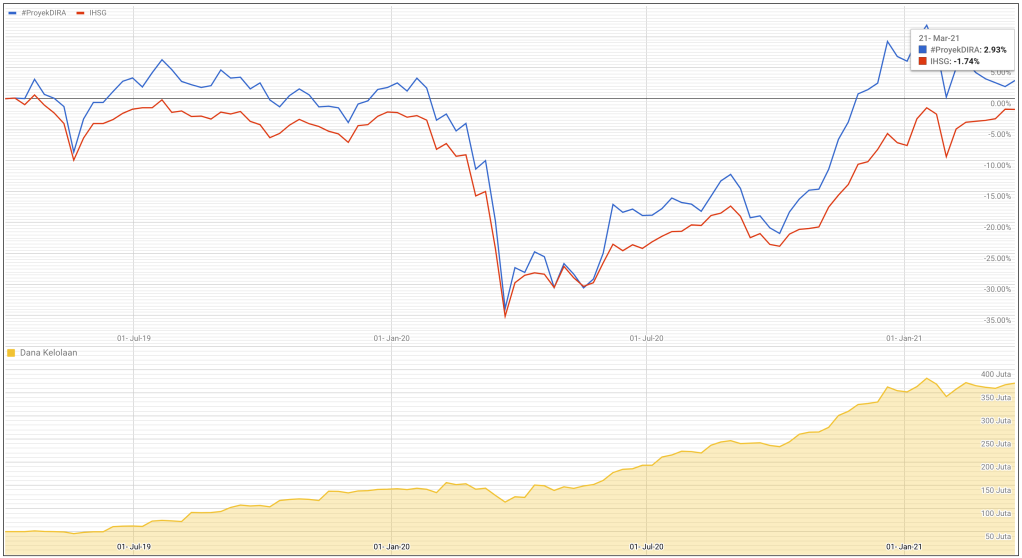
    Bursa saham secara keseluruhan melemah, dengan IHSG turun ke angka 6,356.16 (-0.03% dari minggu sebelumnya). Dihitung sejak kami memulai #ProyekDIRA ini (awal April 2019), performa overall portofolio kami naik +2.93%, sedikit lebih baik dari IHSG yang turun -1.74% pada periode yang sama.

    Perbandingan Performa Historis #ProyekDIRA vs IHSG sampai tanggal 21 Maret 2021

    Berikut Laporan Neraca, Laporan Laba/Rugi, serta Catatan Transaksi yang telah diperbaharui. Laporan tersebut juga dapat diakses dalam format Google Sheets di sini.

    Laporan Neraca & Laba/Rugi per tanggal 21 Maret 2021
    Catatan Transaksi sampai tanggal 21 Maret 2021

    Rizka & Ardhi

  • #ProyekDIRA | Minggu Ke-102


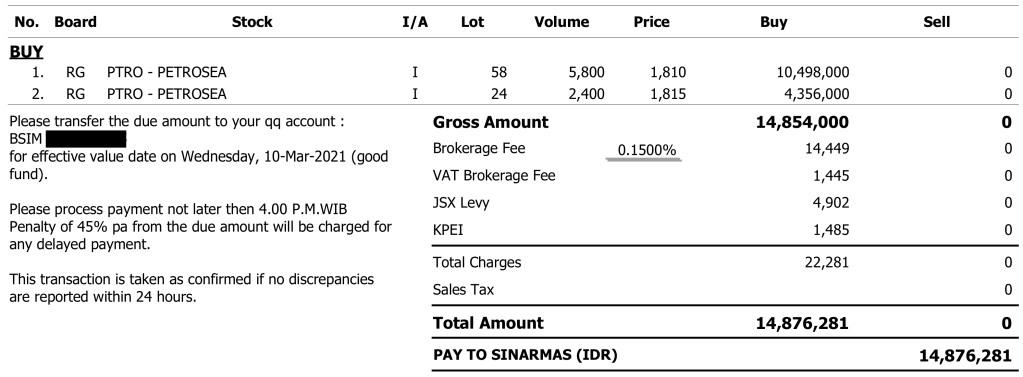
    Sebelum melaporkan posisi portofolio minggu ini, berikut laporan transaksi pembelian saham yang kami lakukan hari Senin, 8 Maret 2021 kemarin.

    • Pembelian 5,800 lembar saham PTRO pada harga Rp 1,810
    • Pembelian 2,400 lembar saham PTRO pada harga Rp 1,815

    Atas pembelian saham dengan nilai Rp 14,854,000 tersebut, dikenakan biaya transaksi sebesar Rp 22,281.

    Konfirmasi Pembelian Saham PTRO

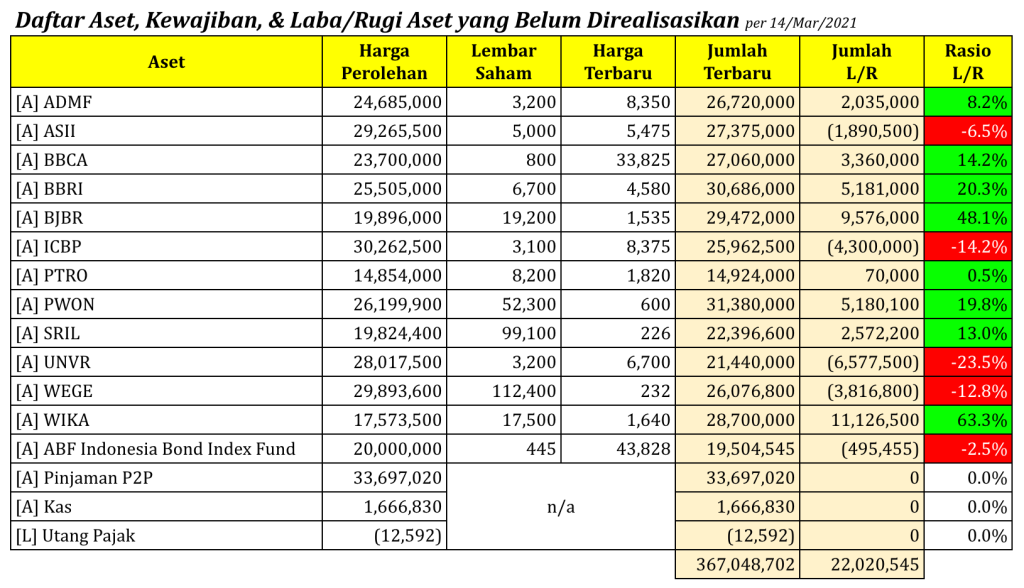
    Per akhir Minggu ke-102 (14 Maret 2021), nilai total portofolio kami turun sebesar Rp -2,254,789 (-0.61% dari minggu sebelumnya) menjadi Rp 367,048,702. Berikut detailnya :

    Laba/Rugi Aset yang Belum Direalisasikan (turun Rp -2,303,865)

    • ADMF turun Rp -320,000
    • ASII turun Rp -125,000
    • BBCA turun Rp -140,000
    • BBRI turun Rp -1,273,000
    • BJBR turun Rp -768,000
    • ICBP turun Rp -387,500
    • PTRO naik Rp +70,000
    • PWON naik Rp +1,830,500
    • SRIL turun Rp -396,400
    • UNVR turun Rp -80,000
    • WEGE naik Rp +899,200
    • WIKA turun Rp -1,487,500
    • ABF Indonesia Bond Index Fund turun Rp -126,165

    Pinjaman P2P (naik Rp +71,357)

    • Imbal hasil pinjaman P2P sebesar Rp +83,950
    • Pajak atas imbal hasil pinjaman P2P sebesar Rp -12,593

    Lainnya (turun Rp -22,281)

    • Biaya transaksi pembelian saham PTRO sebesar Rp -22,281

    Terkait pajak atas imbal hasil yang didapat dari pinjaman P2P setiap minggunya, akan kami bukukan terlebih dahulu sebagai utang dan kami lunasi sesuai tenggat waktu di bulan berikutnya.

    Daftar Aset, Kewajiban, & Laba/Rugi Saham yang Belum Direalisasikan per tanggal 14 Maret 2021

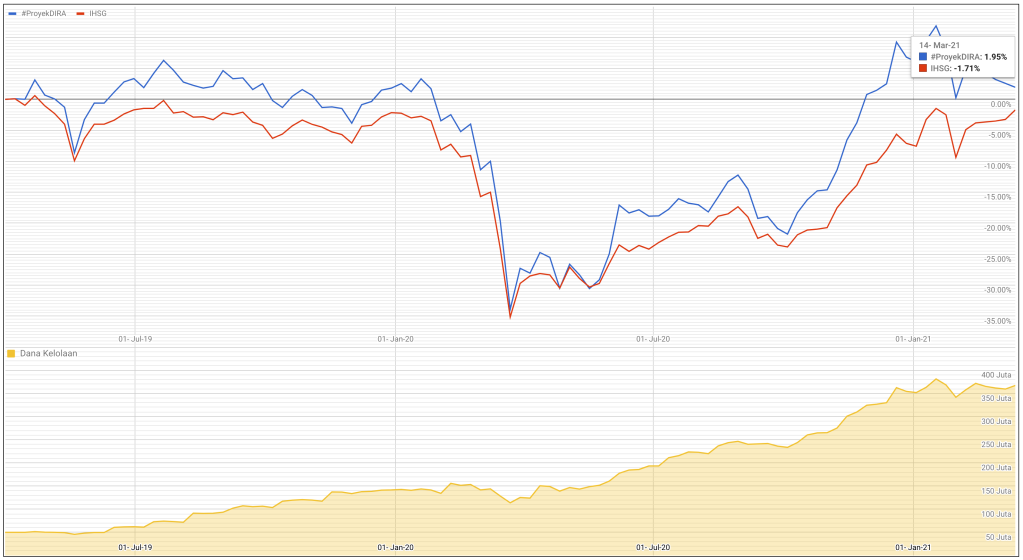
    Bursa saham secara keseluruhan menguat, dengan IHSG naik ke angka 6,358.21 (+1.59% dari minggu sebelumnya). Dihitung sejak kami memulai #ProyekDIRA ini (awal April 2019), performa overall portofolio kami naik +1.95%, sedikit lebih baik dari IHSG yang turun -1.71% pada periode yang sama.

    Perbandingan Performa Historis #ProyekDIRA vs IHSG sampai tanggal 14 Maret 2021

    Berikut Laporan Neraca, Laporan Laba/Rugi, serta Catatan Transaksi yang telah diperbaharui. Laporan tersebut juga dapat diakses dalam format Google Sheets di sini.

    Laporan Neraca & Laba/Rugi per tanggal 14 Maret 2021
    Catatan Transaksi sampai tanggal 14 Maret 2021

    Rizka & Ardhi

  • #ProyekDIRA | Minggu Ke-101


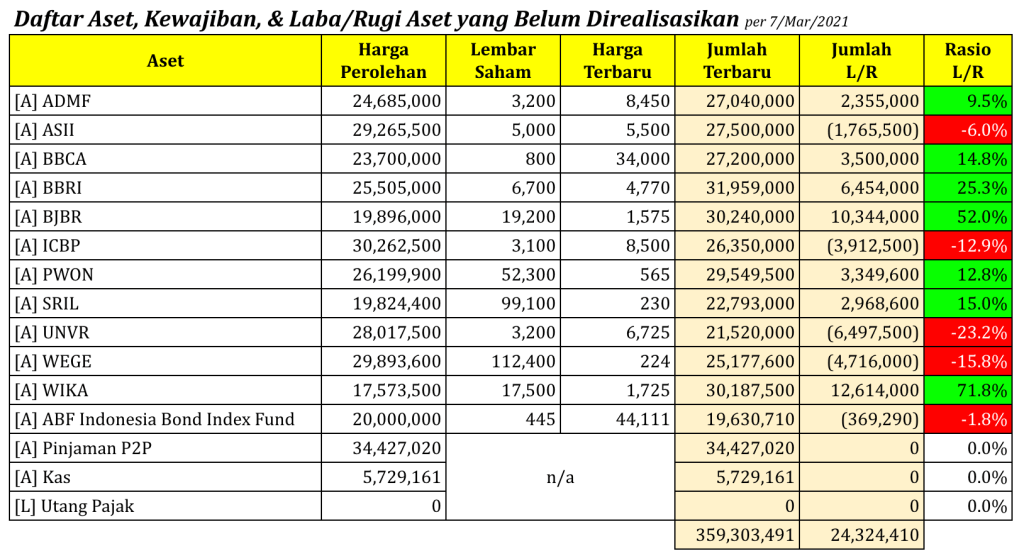
    Per akhir Minggu ke-101 (7 Maret 2021), nilai total portofolio kami turun sebesar Rp -2,216,120 (-0.61% dari minggu sebelumnya) menjadi Rp 359,303,491. Berikut detailnya :

    Laba/Rugi Aset yang Belum Direalisasikan (turun Rp -2,310,743)

    • ADMF turun Rp -240,000
    • ASII naik Rp +500,000
    • BBCA naik Rp +360,000
    • BBRI naik Rp +402,000
    • BJBR turun Rp -192,000
    • ICBP turun Rp -232,500
    • PWON naik Rp +784,500
    • SRIL turun Rp -1,189,200
    • UNVR turun Rp -880,000
    • WEGE turun Rp -1,348,800
    • WIKA turun Rp -262,500
    • ABF Indonesia Bond Index Fund turun Rp -12,243

    Pinjaman P2P (naik Rp +93,840)

    • Imbal hasil pinjaman P2P sebesar Rp +110,400
    • Pajak atas imbal hasil pinjaman P2P sebesar Rp -16,560

    Lainnya (naik Rp +783)

    • Bunga dari kas yang mengendap sebesar Rp +979
    • Pajak atas bunga dari kas yang mengendap sebesar -196

    Utang pajak atas imbal hasil pinjaman P2P di bulan Februari sebesar Rp 85,562 juga telah kami lunasi.

    Daftar Aset, Kewajiban, & Laba/Rugi Saham yang Belum Direalisasikan per tanggal 7 Maret 2021

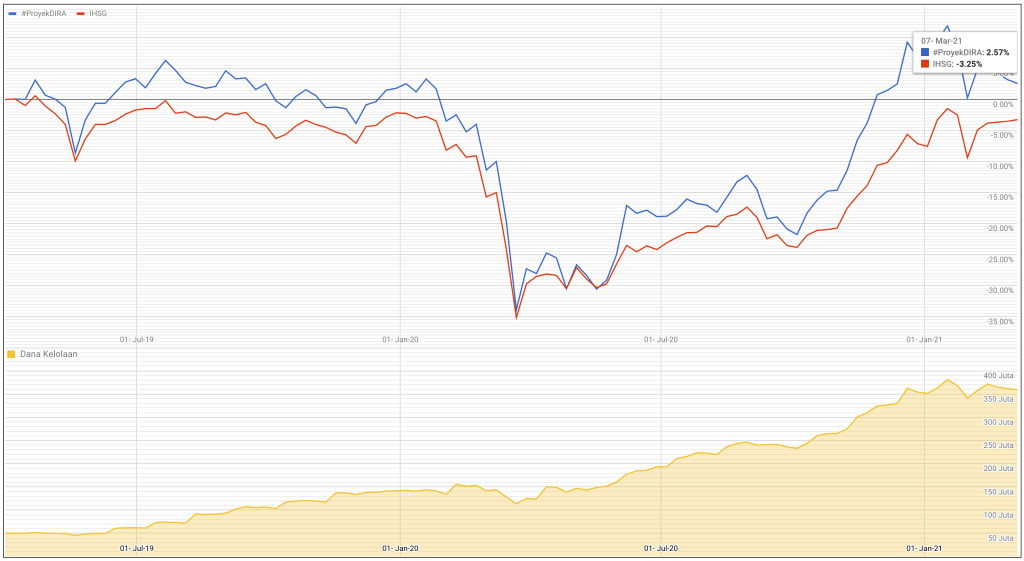
    Bursa saham secara keseluruhan menguat, dengan IHSG naik ke angka 6,258.75 (+0.27% dari minggu sebelumnya). Dihitung sejak kami memulai #ProyekDIRA ini (awal April 2019), performa overall portofolio kami naik +2.57%, sedikit lebih baik dari IHSG yang turun -3.25% pada periode yang sama.

    Perbandingan Performa Historis #ProyekDIRA vs IHSG sampai tanggal 7 Maret 2021

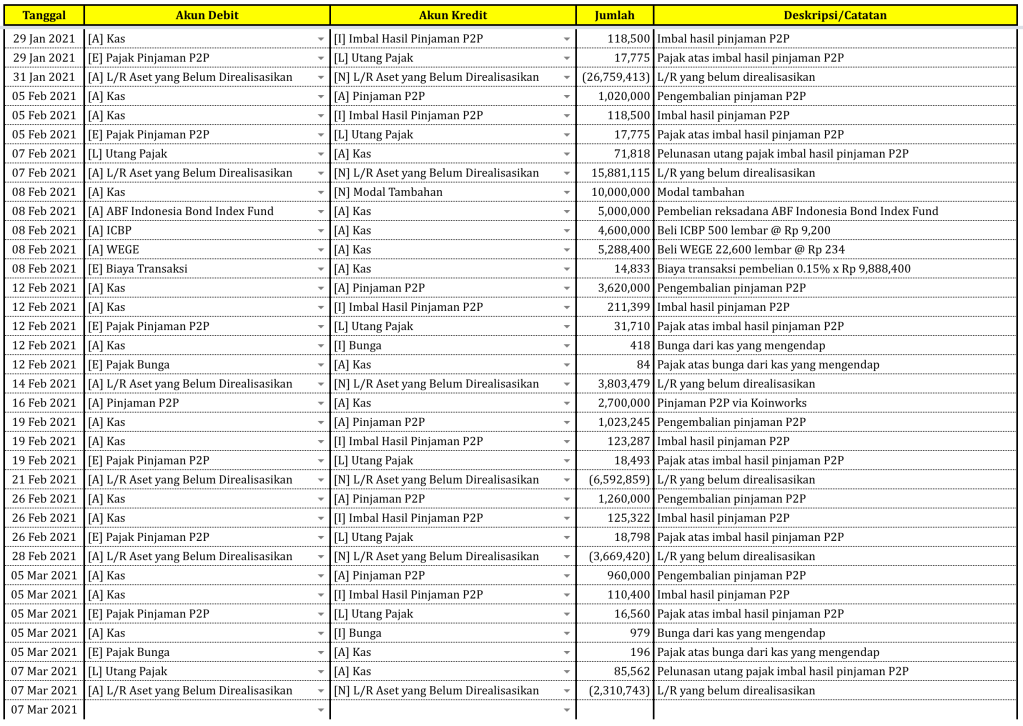
    Berikut Laporan Neraca, Laporan Laba/Rugi, serta Catatan Transaksi yang telah diperbaharui. Laporan tersebut juga dapat diakses dalam format Google Sheets di sini.

    Laporan Neraca & Laba/Rugi per tanggal 7 Maret 2021
    Catatan Transaksi sampai tanggal 7 Maret 2021

    Setelah menyelesaikan berbagai kewajiban di awal bulan, kami dapat mengalokasikan dana tambahan sebesar 10 Juta Rupiah untuk dimasukkan ke dalam portofolio #ProyekDIRA. Rencananya dana tersebut akan kami gunakan untuk membeli saham.


    Rizka & Ardhi